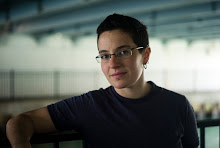
When I was in college, I took 18 credits and worked 3 jobs, leaving little to no time for writing. Homework and fiction were done any chance I got: on the train, on lunch hours, at the laundromat or standing in line at the grocery store. Now that I'm out of school and only work two jobs (writer and swim instructor), my schedule is more flexible and my workspace is more ideal.
But the more time I have, the more picky I am about how, where and when I write. Before, I grabbed any free moment, no matter where I was, but now, if my workspace is not ideal, I find myself less productive. When I'm working on the first draft, in that place where I'm imagining and creating, I find myself drawn to the local cafes and diners, someplace that's quiet, but not too quiet. I prefer working on my Alphasmart or handwriting, finding that the words come more freely without the daunting blank screen or the little red squiggly lines from the spell check. When I'm editing, like now, I'm glued to my dining room table with my laptop, a pot of freshly brewed coffee by my side. Reading is done in the comfy black chair in the living room with a bowl of M&M's or trail mix. I write first thing in the morning and read in the afternoon, knowing that I become less productive as the day moves on.
Writing isn't like any other job: it works the creative part of the brain, the imagination, something that most people can't just "turn on". I've heard so many writers say that they "wait for inspiration", but if you want to make a career as a writer, you don't have time to wait. It's not really about forcing yourself to be creative, it's about training yourself to turn it on on a regular basis. To many, my need to write in a certain environment in a certain time of day is just a manifestation of my extreme neurosis or OCD tendencies. But to me, it acts as a trigger, a signal to my brain that it is time to write, time to create.
The big problem I tend to have is what happens when the work conditions aren't ideal. If I need to run an errand in the morning or go into work, I find it difficult to get my writing done later in the day. I have to remind myself that it's mostly psychological, that just because it's later doesn't mean the day is lost. The work still needs to be done. Everyone talks about how good it is to have a writing routine, but seldom do they mention how difficult it is to be effective when the routine is broken. I still sit in front of the computer or head to the cafe down the street, but the words tend to be labored and don't flow like they do when I'm on schedule.
Enough about my neurosis. What about yours? Do you have a chair, a food, a writing utensil that you absolutely "have to have" in order to write effectively? Are the rituals purely psychological or is it true that you write better when everything is just so?
Sunday, May 27, 2007


Tuesday, May 22, 2007
Let's Talk About Sex

That's right, you heard me. No matter what the genre, (well maybe not in children's or young adult novels), there's a good chance two of the characters will, at some point, hook up. The question is, when two characters have sex, do you shut the door or leave it wide open for the world to see?
 When I was working on my first book, I kind of dodged the bullet when writing about sex. Mayah wasn't in a relationship, wasn't dating, wasn't too concerned with men. There was no sex to be had. But in Street Walk, the main character is a reformed prostitute and the villain is a former john. Sex scenes are inevitable. And admittedly, despite my inner 14-year-old, they were some of the most difficult scenes to write, let alone read aloud. I will never forget how I blushed reading my opening chapter to the critique group. I kept having to stop, take a sip of water, and apologize before continuing. Not to mention when my 85-year-old grandmother read my first three chapters and I had to warn her about twenty times that they weren't exactly PG material. But like Barry says, "You have to show it or the story will suffer."
"Mostly I prefer more of the full monty approach, driven as I am by my enduring inner 14-year-old. But here's the right rule of thumb, I think, at least when your inner 14-year-old isn't calling the shots: does it only matter *that* the characters had sex? Or does it matter *how* they had sex? If the only thing that matters is the fact of the sex itself, showing it is unnecessary and will add nothing to the story. But if the way the characters make love is what matters in the story, then not only should you show it, you actually have to show it, or the story will suffer."
I think he has the right approach. Deciding whether or not to include a sex scene should be like deciding whether or not to include any other scene in the book. You should ask yourself: What is this doing for the overall story? How is it helping push the main plot line forward? Is it necessary?
 When I was working on my first book, I kind of dodged the bullet when writing about sex. Mayah wasn't in a relationship, wasn't dating, wasn't too concerned with men. There was no sex to be had. But in Street Walk, the main character is a reformed prostitute and the villain is a former john. Sex scenes are inevitable. And admittedly, despite my inner 14-year-old, they were some of the most difficult scenes to write, let alone read aloud. I will never forget how I blushed reading my opening chapter to the critique group. I kept having to stop, take a sip of water, and apologize before continuing. Not to mention when my 85-year-old grandmother read my first three chapters and I had to warn her about twenty times that they weren't exactly PG material. But like Barry says, "You have to show it or the story will suffer."
If I look to my favorite mysteries and thrillers, most, if not all, of them include some sort of sex, love, or seduction. I attribute that in part to my love of hard-boiled mysteries and my aversion to Cozies, but a lot of it has to do with the characters. Love tends to raise the stakes. Take an  author like Elmore Leonard. In almost all of his novels he has the protagonist either going after a girl, in love with the wrong girl, getting screwed over by that girl, etc. Love tends to be blind and makes a person do crazy things, and Leonard utilizes that fact in his books.
 author like Elmore Leonard. In almost all of his novels he has the protagonist either going after a girl, in love with the wrong girl, getting screwed over by that girl, etc. Love tends to be blind and makes a person do crazy things, and Leonard utilizes that fact in his books.
As a reader, I can do with or without the sex, it's not that important to me. What I do love in novels is the seduction, the lust, the characters' emotions which drive and often steer their actions. Better yet, I love when the object of desire uses a character's feelings to manipulate those actions. But often times, like when I'm reading romantic suspense, I find the sex scenes jarring, unnecessary. I want to scream at the characters, "Get out of bed! Go find the killer!"
But by sticking with Barry's method, asking if "the way" the characters have sex is necessary to the story, that situation can be avoided. How much to show or not show solely depends on the tone of the book and the type of story you're writing. Put sex in a Cozy and you'll be crucified. Same goes for omitting it in a Romance novel. But in crime fiction, fantasy, and literary fiction, it's more of a gray area. Sometimes you need to shut the door and leave it up to the reader's imagination, other times you have to show the reader everything, let them feel the passion and smell the sweat.
Thursday, May 17, 2007
In Search of Chuck

I am a die-hard Chuck Palahniuk fan. The guy is a genius. He writes the kinds of books I wish I could create. Unfortunately, it seems that thousands of Chicagoans feel the same way. When I heard that he was going to be at the Borders downtown, I anticipated a large turnout and left two hours early, but that still wasn't enough time to beat the traffic. By the time I got there, they weren't letting anyone else into the presentation and the line to get books signed was weaving throughout the store. Frustrated and disappointed, I went to the back of the line and had a seat. I was going to be there for a while.
After finishing the novel I had brought to read, chatting with the weirdo teenagers standing behind me, and perusing the merchandise in the aisle where I was waiting (I happened to be stationed in the Contemporary Christian section and it truly scared me how big the section was), I was beginning to get bored. The reading started at 7pm. It was 10pm and the line had barely moved. Over the loud speaker, the Borders employee announced that Chuck was willing to stay until way after midnight so everyone could get a book signed. While that demonstrated dedication to his fans, I had no intention of standing in line way past midnight, so in an effort to make his night shorter (and mine) I left without getting my book signed and meeting my true literary hero.
Even though it was an ultimately disappointing evening, it was sort of eye opening as well. I have gone to hundreds of signings and author appearances and none had a crowd like this one. First of all, I think I may have been the oldest in the room. Second, I was the most normal looking. Yes, me with the piercings and tattoos felt like a total straight edge. And last, the crowd was rowdier here than any signing I had ever been too, maybe even rowdier than some rock concerts. One guy actually got kicked out for being drunk and had to be escorted out of the store by an elderly Borders manager.

But probably the most surprising thing, was that the crowd disproved many of my stereotypes about the average reader. When I told people at my job, most of whom are around my age, I was going to see Chuck Palahniuk, they responded with blank stares and confused expressions. When I told them that he wrote Fight Club, there was immediate recognition along with the expected, "I love that movie." I always assumed that readers were a minority in my generation, that we are a group which thrives on instant gratification through movies and television. But here were these high school and college age students with stacks of books in hand, willing to wait hours and hours just to meet the author they admire. It was extremely reassuring.
Of course, this is not the norm. Most of the signings I've been to were only attended by a small handful of people. And although every author dreams of being in a situation like Palahniuk, in a way, that is the way I like it. Authors are accessible people. You can see them, talk to them, unlike celebrities in the film and music industries. I can go up to them, shake their hand, and tell them how much I enjoy their writing. Once, I wanted to get Michael Chabon to sign a first edition I bought for Nicole, so I just e-mailed him and he told me to send it over and he'd be happy to sign it. I've met Dennis Lehane at a couple of events and we had a drink and talked about writing. This is a large part of the reason my passion for fiction is so much stronger than my love of movies or music. There is a person behind each word, each page, and after I read a book, I can meet that person face to face and see who it was that told me such a wonderful story.
I have two favorite authors: Chuck Palaniuk and Kurt Vonnegut. I never had the chance to meet Vonnegut. I'm not going to make the same mistake with Chuck. So next time, I'll arrive four hours early and wait with the dyed hair, black make-up wearing freaks. And in a weird, sick way, the wait will be worth it.
Sunday, May 13, 2007
Speak into the Mic
My cousin (another Columbia kid) had one of his films chosen for the Humboldt Park film festival, so last night the whole family went to the big premiere. It was a small screening room with only a handful of people, but my cousin couldn't have been more excited. And with good reason; his 15 minute film was fantastic. He blew the other shorts out of the water.
During the film, I looked back at him and saw the excitement smeared across his face. Here was his film, being played to a roomful of people (not just family members or classmates), the project he's been working on all semester, finally released to the public. It may not be the Landmark Cinema, but it's a start.
It reminded me of the first time I read in front of an audience. Columbia College was big on having their students read, wanting them to get used to reading aloud in front of an audience. My hands were trembling, my heart was racing, but to have a bunch of people listen to my work, if only for a minute, was truly thrilling.
I know many authors who hate to read their work aloud. I've seen many get in front of that microphone, take one look at the audience and panic. Others, including myself, can't get enough of it. I don't think it's an ego thing. The work sits on my computer, these pieces of fiction that I've worked so hard on creating, and I finally get a chance to share them with the world (or just a group of creative writing students).
But when you're published, whether it's a book or a short story in a literary magazine, chances are, someone is going to want you to read, and if you've never done it before, it can be a nerve-racking thing. My advice? Read wherever and whenever you can. Practice being in front of the microphone. Even if the work is not finished, it can be a highly effective form of critique to read a work in progress in front of an audience. Do they laugh at the right places? Do they seem interested? Are their eyes glazing over?
Don't know where to read? If you're in Chicago, here are a few places to check out:
Twilight Tales - Weekly readings, lots of open mics, mostly crime fiction and dark fantasy
Reading Under the Influence - Monthly reading, must submit in person the previous month, 750 words or less, the perfect combination of drinking, fiction, and trivia. Not to mention great prizes!
Kate The Great's Book Emporium - Frequent readings on various themes, some open mics, but you can submit to be a featured reader.
Tamale Hut Cafe - Readings every second Tuesday of the month, mostly open mics.
Those are the main ones that are on my radar, but please, comment with your favorite places to read, in Chicago or elsewhere.
Monday, May 07, 2007
Choose Your Own Wiki
A friend of mine just launched this super-fun website called, Choose Your Own Wiki. It's like those "Choose Your Own Adventure" books, except online and, well, you write it. They have two stories already started and you just add to whatever chapter you want. It gets kind of addicting...
In an effort to beef up their content, the first person to publish 50 meaningful chapters will get their own story start, so get to writing!
In an effort to beef up their content, the first person to publish 50 meaningful chapters will get their own story start, so get to writing!
Sunday, May 06, 2007
Requested Retraction
On behalf of my girlfriend, Nicole, I would like to print a retraction for my post Switching Teams. She says:
"I think you got it a little wrong. I am a VERY loyal reader. I still bought Chabon's book. I still intend to read it. Just b/c I am not happy with his move to the 'other side' as you put it, does not mean I would abandon him!!!! "
She also expressed concern that Michael Chabon would read my blog and think that she was a total bitch. So Chabon, if you're out there, Nicole is not a bitch and is truly your number one fan. In fact, she's taking off work so she can come see you when you appear in Chicago.
And I'm also sure she would like me to say that any author would be lucky to have her as a reader. If you're her favorite author (and she has many) not only will she read every book you've ever written, but even if she doesn't like a few, she'll still pretend that she enjoyed it.
Anything else, honey?
What's in a name?
I've never been good at titles. They just don't come easy to me. Since I've only written a few novels, I haven't found out if practice really does make perfect. When my friend Marcus told me that he needed a new title for his second book, I wanted nothing more than to help him. I sat for few hours, brainstorming, flipping through pages of quotes, scrolling through books on Amazon, but nothing came. The fact is, I liked his original title, even if his publisher didn't, and it was hard for me to think of his book by any other name.
The other day, I had coffee with another writing friend and, as always, I asked him what he was reading. "That Harlan Coben book," he replied, "The Innocent? Innocence? I always forget the names of books!"
So it got me thinking. How important are titles? Publishers seem to think very. But what about readers? Personally, I have never bought a book or picked it off the shelves simply because it had a gripping title. In fact, I've bought quite a few books despite the title because of a review I read or a friend's recommendation. Is it just me? Is the title of a book a real deciding factor for most people?
In his blog, Marcus writes:
"Despite the lesson we're taught in childhood, people do judge books by their covers--and their titles. And why not? First impressions matter. And where a cover design assumes the reader is holding the book, and can flip it over to read blurbs and a summary, a title has to stand on its own. It has to be memorable and suggestive, with the right balance of poetry and punch..."
I agree that a good title resonates long after I read a review or hear it mentioned at a party. Titles like "Please Kill Me" or "Be Cool" draw you in immediately. Others, like "Positively Fifth Street" or "Hairstyles of the Damned" are suggestive, give you a flavor of the book before you even read the back cover. But do they truly make or break the sale? After all, I bought "Welcome to Temptation" and "Faking It" despite the pastel covers and suggestive titles (both excellent reads by the way).
The conclusion I seem to be drawing is that while a bad title doesn't necessarily break a book, a good title can certainly make it, so why not spend time developing the best title possible? And there must be something to it if publishers and booksellers are so concerned about it. However, for newbie novelists such as myself, the top priority should be writing the best book possible. Don't spend so much time dreaming up the most perfect, poetic, resonating title. After all, isn't the publisher going to want to change it anyway?
I'd love to hear people's opinions on this. Are there books out there that you bought just because of the title? Do you even remember titles? When it comes to book buying, what's in a name?
Sunday, April 29, 2007
New Gig
I am starting to review books for the Chicago Sun-Times. I am stoked to be writing for such a wonderful publication. My deadline isn't until the end of May but I will be sure and announce when my first review is in print.
Switching Teams
I love books. I love reading them and writing them. When people ask me what kind of stuff I read, I reply by saying, "Everything." Sure there are certain types of books or certain story lines that aren't my cup of tea, but in the end, good writing is good writing, no matter what the genre.
My girlfriend is not like this. She likes Literature with a capital L. I don't think she's ever set her eyes on the popular fiction section in Borders. The opposite is true of others. I've met plenty of people who only read mysteries, or romance, or sci-fi. This is not a criticism by any means; people like what they like. Who am I to argue?
 This morning, I finished one of the best books I've read this year: The Price of Silence by Camilla Trinchieri. It's a beautifully written novel with intriguing characters and I couldn't put it down. I told my girlfriend that she would love it and she asked if I was reviewing it for Crimespree. Immediately, I knew what she would say when I told her I was: I just don't like mysteries. So I found myself trying to convince her that she would like it, telling her it was character driven, that crime wasn't the focus, etc. It's all true. In fact, if I was a bookseller, I wouldn't really know where to shelve it.
Later this afternoon I was reading the books section of the Sun-Times and saw that Michael Chabon's latest book was reviewed. My girlfriend is, I think, THE biggest Chabon fan. She pre-ordered The Yiddish Policemen's Union weeks ago and has cleared her schedule so she can read Tuesday, the moment it comes out. But when I read her snippets of the review, one in particular stuck out:
"Chabon unleashes a noir murder mystery that is part Raymond Chandler, Part Isaac Bashevis Singer..."

In my mind, being compared to Chandler is an incredible compliment, but to Nicole, it was cause for worry. Here is one of her favorite authors, the creator of Kavalier and Clay, she's been looking forward to his latest book for nearly a month and what does she get? A "noir murder mystery."
I am open minded when it comes to genres, but my girlfriend demonstrates that most aren't. Most readers have great genre loyalties and when beloved authors cross over to the dark side (or just to the other side of the bookstore) they run the risk of losing fans. Tess Gerritsen blogged about her experience when Harlequin began re-releasing her old romance novels. She says:
"The problem is, my readers get upset with me when they buy a Tess Gerritsen book, expecting a gritty thriller, and find they’ve bought an old romance novel. My first reaction is to say to them: ”Hey, try it, maybe you’ll like it.” But a lot of them think they’ll get cooties or something from reading a romance, and then they write me angry letters. Or even worse, they stop buying my books altogether."
Because I am as open minded with my writing as I am with my reading, this scares the hell out of me. Sure, I love writing mysteries/thrillers, but what about later? Will I always want to stay in this genre or will I get an idea for a story that's totally different? Should I be more careful about the genre I write in now because it's what I'm going to be writing for a really long time? Or do I go back to my artist attitude of "write what's pulling you" and not worry about my future in publishing?
Once your published, developing a fan base is extremely important. But those fans aren't necessarily loyal to you, they may be loyal to your genre, to your brand. They may be loyal to your serial killers, your government conspiracies, your social commentary. Change your product, they may go looking for a new brand. Trust me, if my girlfriend can doubt the brilliance of Michael Chabon based on genre, your fans can and will do the same.
In my mind, the story is what's important. Good writing is important. Interesting characters are important. In the end, I could care less what shelf I found the book on. But am I the minority? I'd love to hear everyone's thoughts.
Thursday, April 26, 2007
Curve Article

Want a funky new haircut? Check out Not Your Mama's Beauty Parlor, my latest article in Curve Magazine.
Monday, April 23, 2007
Who You Know
Most writers I know, defy the stereotype of the loner, Salinger-like author that never goes out and has no friends. In fact, writers are some of the most sociable people I know. Maybe it's because we know how to tell a story, maybe it's because we can all bond over our love for books, but whatever it is, we can drink and chat until the wee hours of the morning.
Over the years, I have acquired numerous writing buddies: people in my critique group, people I went to college with, people I met at conferences, on Backspace, through the blogosphere. The act of writing is such a solitary experience, that it feels nice to walk away from the computer and have a drink with people that know exactly how it feels.
When I've mentioned the authors or reviewers I know to people outside the community, I have gotten the same response: "That must really help your career!" In the beginning, I never really thought about it like that. When I'm talking to people at writers conferences, I never think about how they can help me. And I think we've all been in that situation. Someone introduces themselves and immediately, you get the vibe of "I hope your someone important because otherwise I won't waste my time talking to you." It's awkward, the conversation is strained, and connections aren't made.
That being said, I attribute many, if not most, of my successes and opportunites to people I have met. I began reviewing books for Crimespree because I met Jon at Love is Murder. Reviewers like Sarah Weinman and David Montgomery have recommended me to their editors. Ken Bruen, bless his heart, not only read but blurbed my yet-to-be-published novel. When I met these generous people, I wasn't thinking about what they could do for me. And it's because of that, because I had no hidden agenda, that they have done so much.
When it comes to publishing a novel or getting freelance gigs, your work is what's important. It doesn't matter who your friends are if you have a bad product. Honing your skills, perfecting your craft, and writing the best book you possibly can should be priority number one. Networking comes later. Knowing people in high places may get your foot in the door, but it's not going to close the deal.
The world of publishing is a tough one and I'll do anything I can to help another writer out. Fortunately, other members of the community feel the same way. We look out for each other, push each other's books, listen to the experiences of others and dole out advice when we can. The act of writing may be solitary but the act of publishing certainly isn't. It goes back to the old saying: it takes a village to raise a child. And man, we've got quite a village.
Sunday, April 15, 2007
MFA or CPA?
The occupation of "author" is perhaps not the most practical career choice. It probably goes along with "musician" or "painter" in terms of stability. But I emphasize career choice; you choose what you do for a living. My knack for writing could have been applied to numerous jobs, practical jobs, ones with vacation time and a 401k. But I chose freelancing, I chose novel writing, despite the lack of stability. It's what I love and I know I cannot be happy doing anything else.
Tess Gerritsen had an interesting blog post about the lack of Asian-American authors, saying that as a race, there is much emphasis on the sciences and families encourage their children to pursue careers in that field. Gerritsen became a doctor before pursuing her career as a novelist, and she wonders how many Asian-American Pulitzer Prize or Academy Award winners are out there working in the sciences.
I completely understand where Gerritsen is coming from, but I don't think it is simply an issue of racial differences. Although culture and upbringing play huge roles in shaping a child's future, I think many, if not most, Americans are working somewhere other than their dream job. How many people have told you, "I've always wished I was a rock star/movie star/president/etc?" Far more, than people who have told you they love what they do and wouldn't want to do anything else.
But it's more than just doing what makes you happy, it's also doing what your good at. I love to sing, but I save it for the shower because I sound horrible. Scratch rock star off the dream job list. My mother always wanted to be a forensic scientist, but flunked high school chemistry because she accidently burnt all the textbooks with acid. Talent+Passion=dream job. Can't have one without the other.
So that leaves us with the people who have a talent for something, but don't have a passion for it. My girlfriend is a brilliant accountant, but it's hard for me to believe that she'd rather audit than do anything else. Why does she do it? Because, as she says, "Having a CPA is like money in the bank. I'll always have a job." She does it for the stability (and the nice paycheck). My father, when he was in high school, told his mother that he wanted to be a plumber. She gasped and pleaded for him to set his goals higher, but he said that being a plumber was a stable occupation, that he would never be without work. (Side note: he is now an accountant).
Writing was never seen as a stable occupation, and now, with people reading less and less, it seems even more impractical. But to me, going to school for creative writing wasn't as dumb a decision as practical people may think. Writing is a skill, a trade, and I went to school for it. In nearly every career, writing is a necessary skill, one that many professionals, sadly, do not have. To me, I can always get a job writing and my degree is far more "practical" than others.
I've always had a "follow your bliss" attitude, but I can see where it's difficult for others to have the same. Stability is important, but to me, it's more important to do something you love. Fact of the matter is, whatever you love to do and whatever you're good at, there's someone out there who will pay you to do it. My girlfriend has a passion for tea and a knack for business and I always tell her to open up her own tea shop. My mother loves helping people and is great at solving problems and listening, so she became a therapist. I love to tell stories so I became a writer, and can be one of those people who say, "I love what I do and wouldn't want to do anything else.
Monday, April 09, 2007
Where is your ARC?

I just got back from a wonderful trip to San Francisco, a city I had never been to and will hopefully return to soon. Like most tourists, we hit up Alcatraz and Fisherman's Wharf, took long hikes, drove across the Golden Gate bridge, etc. But with every new city I go to, unlike most tourists, I check out the mystery bookstore. This one was a quaint storefront connected to a house where, I assumed, the owners lived. Perusing the shelves, I happened upon a whole wall dedicated to advanced reading copies, all adorning the labels "uncorrected proofs" and "not to be sold". I asked how much the ARCs were going for and the counter person told me that they were all ten dollars. Guess they ignored the labels.
It is my understanding that authors (or their publicists) send ARCs to bookstores so the owners can read them and hopefully recommend them to customers, not to make a profit. The author receives no compensation for the sales of ARCs. My initial reaction was frustration. Authors slave away for a year writing the book, they send out ARCs to put their names out there and hopefully generate sales, but instead of reading the books, this bookseller just places them on a shelf to generate revenue for themselves. I have expressed this frustration in a previous post regarding used books; authors should be compensated for their work.

But then another thought came to mind. The point of these advanced copies is to put your name out there. You send them to critics to get reviews and to booksellers for customer recommendations. So even though you don't receive royalties for the ARCs sold, you could potentially gain readership and therefore ensure future sales. But perhaps this is being optimistic.
My girlfriend is into book collecting. Okay, she has become an addict of book collecting. She seeks out first editions, rare printings, anything she thinks "could be worth something someday". To her, the ARCs are an investment, and she seriously considered purchasing an ARC of The Blade Itself (even though she already has three first edition, first printings) because she thinks it will gain in value. When she buys a rare first edition online or from a book dealer, the author doesn't receive compensation from that sale either, so does the same go for ARCs? Because they're rare, do they cross over into the realm of collector's item?

Call me a stickler or a goody goody, but I feel like if something says "not to be sold" I don't think it should be sold. Why should someone make a profit off of my work without giving me a cut? But I'd like to put it out there for the published authors (or non-published if you have an opinion). How do you feel when you see your ARCs on Ebay or being sold at local bookstores? Does it help build readership? Is it good publicity? Or is it just someone trying to make a buck off of your hard work?
Sunday, April 01, 2007
Too Predictable?
I've always been good at predicting movies. When I saw The Sixth Sense I figured it out halfway through and ruined it for everyone in the theater. Primal Fear and The Illusionist, which were known for their "twist" endings, didn't fool me either. For me, the mark of a good movie or book is the ability to surprise, for the ending to be unexpected but make sense at the same time.
So when I got feedback on my third draft of Street Walk, I was very disappointed to hear that both my mother and girlfriend figured out the mystery on the same page, chapters before the big reveal. Where I thought I was just dropping a hint, a seed to make the ending tie in later, I was actually giving it away. They both assured me that they still loved the book and there was still the suspense of how the killer was going to be caught, but it didn't change the fact that, in my mind, my book was predictable.
When I had lunch with Lee Child a few Bouchercons ago, I asked him about eliminating predictability in books and how important it was to him that people didn't figure out the mystery too soon. He said that even if a person thinks they've figured it out, they'll still read to the end to see if they're right and ultimately, you just want the reader to keep reading.
For someone like me who becomes a harsher critic with each book she reads, figuring out the ending too soon definitely changes my opinion of a novel, especially a mystery. If the whole attraction of the genre is to figure out the who and the why, wouldn't a predictable ending defeat the purpose of reading? While some people may find satisfaction in figuring out the killer before the big reveal, I get disappointed, thinking that it was the writer's job to fool me and fool me well.
There is certainly a fine line between revealing too much and too little. Give away too many clues and readers will figure it out prematurely. Withhold too much and readers will feel cheated, like it came out of nowhere. Authors use red herrings to steer readers in the wrong direction, but if a character is too likely of a suspect, it's a safe bet that they didn't actually do it.
Ultimately, crafting the mystery seems like every other aspect of writing: practice makes perfect. So I will return to my manuscript and make the necessary changes, not wanting my story to be predictable. But I'd love to hear everyone's thoughts. How important is the element of surprise? If you figure out the mystery too soon, does it change your opinion of the novel? Or does the saying ring true, is it about the journey and not the destination?
New Tess Gerritsen Post
Today, Tess Gerritsen writes about what to expect when tackling the second draft. Definitely know where she's coming from!
Monday, March 26, 2007
Advertising in Novels?
J.A. Konrath has a very interesting blog post about funding books with advertising dollars. Being who I am, I'm against using product placement and ads to fund my novels, but it's an interesting concept nonetheless.
Query 101
The Truth: I nearly failed Freshman English. I can't spell worth a damn and I still don't know what a participle is. I run into my grade school Language Arts teachers and when I tell them I'm a writer they laugh and assume I'm joking. Originally, I was destined for business. In high school, I was the DECA state champion and I went to Michigan State University with plans to obtain a marketing degree. Even though I soon realized my passion for creative writing and transferred to Columbia College, my business mind has never left. I may die without spellcheck and I may consult The Elements of Style on a regular basis, but when it comes to query letters, it's all about the marketing.
There are all types of query letters with all sorts of structures and formats, but there are a few universal truths when querying an agent or editor.
1) Do your homework. Visit the agent or editor's site and see what authors and genres they represent. Yes, this takes time, but in the end, it's worth it. When you write your query, be sure to show the person that you have done your homework. Tell them why your book would be a good fit.
2) Grab from the get-go. If you've ever been to an agent or editor's office, you have seen the piles. They have stacks and stacks of query letters to go through, all of which get read but only a few make it to the next step. It's important to make your letter stand out, primarily in your pitch. You only have a paragraph to say what your book is about, so you better make it good. Test out your pitch at writer's conferences, with your critique group, with your mom, whoever. See if it grabs your attention. If even you mother's eyes glaze over, it won't grab an agent's attention.
3) Show that you're serious. Before they even get to your manuscript, an agent or editor wants to know that you're a serious writer, not just someone who spewed off 80,000 words one weekend. Any publishing credits and awards received should be included in your query (usually after the pitch paragraph). If you have a BA or MFA in creative writing, all the better, especially if the MFA is from Iowa. None of the above? Put down that you've attended writer's conferences and/or seminars where you have networked. You're not just selling your manuscript, you're selling yourself.
4) No mistakes. Read it twenty times if you have to, but you're query letter should be free of misspellings and grammatical errors. It's not just a query, it's a demonstration of your writing abilities. If you make two mistakes in a one-page query, how many mistakes will be in your manuscript?
5) SASE. Always, ALWAYS, include a self-addressed stamped envelope with your submission. Without it, even a kick-ass query will be tossed aside.
Little things: Some of this is personal preference, so take it or leave it.
- I don't like questions in the query letter. I have read many queries that end on, "May I send you the first three chapters?" It doesn't sit well. I'd go with, "I look forward to sending you the complete manuscript." It's confident and shows that your novel is ready to be submitted.
- Always include what you have enclosed along with the query letter. If for some reason your SASE or pages get misplaced, the agent or editor will know that you included them in your submission.
- If you have a blog or website, include it with your contact info, under your e-mail address or in your heading. My homepage has numerous short stories posted along with my resume, so people can look at it before responding. I landed two freelance gigs sending nothing but a pitch. The editor said she was sold after looking at my webpage. Going back to point #3, blogs and webpages show your seriousness.
- Name dropping is not a crime...if it's done tactfully. Agents and editors will find you more appealing if you have a network of writers that would provide blurbs when your novel comes out. If one of those writers is represented by the agent you're querying, all the better. Here is a sample from one of my agent queries:
I received my B.A. in fiction writing from Columbia College Chicago, where I studied under great authors such as Patricia Rosemoor and Joe Meno. My uncle, Lee Child, has also been a great mentor to me. Each of these authors has agreed to provide blurbs for my novel.
For me, the book Agents, Editors, and You has been very helpful, as well as Hallie Ephron's Writing and Selling Your Mystery Novel. Writing a good query takes practice, but hopefully, if you follow these suggestions, it won't be long before an agent or editor asks for pages.
Wednesday, March 21, 2007
Chicken and the Egg
How many times have you heard the following responses to "What's your book about?"
"It's Pulp Fiction meets Lethal Weapon...with penguins..."
"It's a high concept techno thriller with a dash of romantic suspense."
"It's about this guy...(This is where you zone out because no one should start their pitch with these four words)"
So how does an author begin a book? Do they start with a concept and develop characters along the way? Or does the idea stem from "this guy" and the plot forms from there? What comes first, the characters or the plot?
For me, it's been both. Thou Shall Not began with a group of people: ultra-orthodox Jews in Israel. I knew it was a world that most people didn't know much about and thought that many would be interested. While that was marinating, I read a newspaper article about a small scandal in New York where prevalent Rabbi's were caught soliciting prostitutes. This happens quite often, especially in Israel, but I knew that the story shocked most of America. Add some murders and a crime reporter who deviated from the community and came to Chicago and I had my first novel. However, with Street Walk, the character came first. Suzanne, a former prostitute who left the business after being attacked. Then I thought about how to make it worse. I made her pregnant when she was attacked and now she's living on Chicago's north shore raising her daughter. I had no idea what the plot would be, but the character intrigued me so much, that I let the plot stem from her.
I know many writers who start off with a genre, or a concept, and let the characters and plot form around that. Joesph Finder created the new sub-genre "Corporate Thrillers", thinking that since most people work in corporate America, they'd enjoy reading about it. Tess Gerritsen, after writing Romance novels, wanted to put her medical experience to use and write a medical thriller. It's hard for me to believe that writers such as Dan Brown or Michael Chrichton start developing their characters before thinking about plot.
Is one method better than the other? Of course not. Authors can't control where they get their ideas or what they think of first. But I do believe the final product is different. The aspect the author spends more time developing, will be the driving focus in the finished manuscript.
Take a book like Mystic River (okay, I know I'm a total Lehane-head, but the guy is brilliant.) What do you remember most about that book? The characters and the relationship between them. It's hard for me to believe that Lehane first developed the plot of that book before thinking about the characters. What about Jurassic Park? I don't think Chrichton first thought of a scientist and developed the character before even thinking about the concept.
Ideally, the final product would have both. Authors like Gayle Lynds and Lee Child manage to create both memorable characters and high-concepts. The important thing is that the story is compelling, whether it's the plot or the characters driving the story forward. We can't control what ideas come into our head, what thoughts preoccupy us until we put them down on paper. But even if you think of a plot idea or a concept first, it's important to create characters that are multi-faceted and will add to the story. Conversely, a book cannot ride on characters alone; you need a gripping story that will keep readers turning pages.
Thursday, March 15, 2007
From Fiction To Reality
When I created this blog, I promised myself that it wouldn't turn into an indulgent, "look how great I am", attempt at self-promotion, or worse, an unstructured rambling of any thought that comes into my head. I wanted to share my experiences and opinions, which are hopefully helpful and a bit entertaining. But this is something I can't resist sharing although I can assure you, it won't be helpful in anyway and may not be entertaining to anyone other than myself.
#1 The Fiction: In my latest book, I needed a way for my main character to live in an affluent suburb even though she's a waitress and has a five year old daughter and probably couldn't afford anything in that area. After much brainstorming, I decided to have her strike a deal with her landlord that she'd clean the common areas of the building in exchange for a reduced rent. Problem solved.
The Reality: In September I moved into my very spacious yet very affordable apartment. It was a sublet, so the lease is up at the end of April and my landlord sent me a letter regarding possible renewal. The letter informed me that my rent would be raised by about 10% if I wished to continue living here. That, I can't afford and really, I don't want to spend the money to move again. After lots of negotiating (okay, arguing) about how much my rent should be, seemingly out of nowhere, I blurted out, "What if I clean the common areas for a reduced rent?" Seriously, I surprised myself. But she agreed and I will continue to live in my very spacious yet very affordable apartment.
#2 The Fiction: Last summer I started a short story about a girl overcoming drug addiction who joins a swim team, knowing that regular exercise is an important part of recovery. But as the year continues, she finds herself getting addicted to swimming, going to the pool three times a day, getting tremors if she doesn't get enough yardage, etc. Basically, I've always said swimmers are slightly sadistic and have to be a little crazy, and thought it would make for an interesting story if I exaggerated the hell out of it.
The Reality: When I joined my masters swim team this summer, I started going two days a week. When my work schedule shifted, I was able to go three, sometimes four days. On Tuesdays, when I can't make it to practice, I swim at my gym. Then, in December, meet season started, so I started competing on Sundays every few weeks. My girlfriend thinks it's starting to get out of hand. Our team has a "mile-a-day" challenge where the goal is to swim 365 miles in 2007. To keep track, we have a spreadsheet where we input our yardage every day. Last week, I looked it over and saw that I swam every day for three weeks. No break. No rest. In April, we're going to San Francisco and while my girlfriend is looking up restaurants and things to do, I go online and search for pools. When I tell her there's a masters team that practices down the street from our hotel she gives me a look that says, "I will leave you if you go to swim practice on our vacation." I'm starting to agree that I may have a problem. My name is Dana and I'm a swim-aholic.
We always talk about putting ourselves in our characters, giving them traits that we possess. But I never knew it was possible to actually become our characters, become like the fictional people we have created. Anyone else? Am I the only one?
Monday, March 12, 2007
The Reviewers' Plight
The other day I received a call from a fellow writer/reviewer stating some concerns about books he was scheduled to review.
"I have two books," he tells me with a sigh. "One was really good, but the author totally cheated at the end and it really pissed me off. The other one was okay, the writing wasn't too great, but it was good enough that I can review it."
My reaction was he can review the first one and state his frustrations about the ending, or just not review it at all. As for the other one, why did he keep reading? If I'm not liking a book, I put it down. Life's too short to read bad books. But he told me he had three books on his stack and was afraid he wouldn't like any of them and couldn't go to his editor empty handed.
In a perfect world, reviewers would love everything that comes across their desks. Unfortunately, that's not the case. We have to make judgement calls and tough decisions about what to review and how to review it. Most of it depends on the publication. Crimespree doesn't publish bad reviews (with all the ARCs they get, they don't need to waste time reading bad books) while Time Out Chicago wants brutal honesty. Truthfully, when I read a book like my friend did, where the author cheats at the end, every part of me wants to vent and tear the book apart. But most of the time, it's refreshing to read what you want and not be pressured to get through a book that you seriously dislike.
But most books aren't so clean cut. There are books that I love and books that I hate, but most fall somewhere in between. Most books are well written but have plot problems. They have interesting characters but not enough suspense. So, what to do? Generally, if the author kept my interest for 300 pages, they're doing something right. If I made it to the end, it's getting reviewed. But what if there were significant problems with the plot, or a character, believability, etc.? I give credit where credit is due, writing about the good things and dropping no more than a line about the bad. The reader can take it or leave it. Fact of the matter is, we all have different tastes. I'm more into character driven novels, but someone else may enjoy the high-concept novels with less character development. I did not particularly care for The Da Vinci Code, but I can think of thousands of people who did. Something that I may view as a weakness, someone else may see as a strength.
As with blurbing authors, reviewers run the risk of losing credibility. Write too many good reviews of bad books and you will surely lose your audience. Write too many bad reviews and authors will hiss at you at writers conferences. Be honest and you'll maintain your credibility. Yes, I write a lot of positive reviews, but that's because the bad books don't get reviewed. It's hard enough for authors to sell books without some critic writing about how bad it is. Like my mother taught me: if you can't say anything nice, don't say anything at all.
I can't speak for every reviewer, but most of us got into this business because we love books. We're not disgruntled authors who could never get anything published so we decided to degrade the work of others. We love reading, love a good story and love discovering new authors. We sometimes have to read books we don't want to, or write reviews that aren't stellar, but in the end, the hope of finding a book we adore makes the whole process worth it.
Subscribe to:
Posts (Atom)