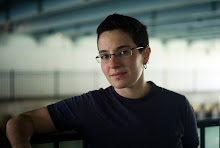
I remember when I was applying to Columbia, one of the essay questions was to write about the moment I knew I was an artist. While I can honestly say there was no point in my life when I thought I'd be any type of artist, there were plenty of moments when I dreamed of some day becoming a writer. I could have written about the time in my middle school language arts class when I argued with my teacher over a creative writing assignment because she said the stories couldn't be science fiction or romance. I could have written about my creative writing class in high school, when I was asked to read my story aloud, and how exhilarating it felt to read my work in front of an audience. I could have written about my awful semester at Michigan State, the semester I posed as a business major when the only thing getting me through each day was my writing. But instead, I wrote about reading, because whenever I was curled up with a book, I knew that this is what I wanted to do.
I reached out to my fellow writers and reviewers and asked them a simple question: What three books made you want to be a writer or reviewer? What books made you want to get into the world of publishing? Everyone had trouble limiting it to just three, but I think it is interesting to see what everyone replied with. For me, my three books are The Bell Jar, The Perks of Being a Wallflower and Mystic River. The first I read in 7th grade (probably not recommended) and it was the first time I realized that I could enjoy reading. The second gave me permission to write how I speak, which made me want to be a writer even more. The last, I read in college, so I was already was on my way to becoming a writer. But it is beautifully crafted and so well written, that after I finished it, I knew it was the type of book I aspired to write.
Click on the links to see which authors picked the books and get out your reading list:
Catcher In The Rye
East of Eden
The Long Goodbye
Snow Falling on Cedars
Salem's Lot
First Blood
Lord of the Flies*
The Fountainhead*
The Books of Blood*
*submitted by Marc Paoletti, author of upcoming novel Scorch
Anywhere But Here
My Traitor's Heart
The Last To Go
To Kill a Mockingbird
I, The Jury
The Neon Wilderness
On Writing Well
Moi, Pauline
A Drink Before The War
Jon over at Crimespree, wrote, "Reading George Chesbro did it for me because I wanted more people to read his books.His books were all but out of print and the last two hard covers to come out had a very small print run."
Author Laura Caldwell said, "This is probably not helpful, but for me it was the lack of books that gave me the idea to write. I was standing in a Super Crown, searching for a book. I kept thinking that I wished there was a book about a woman who went on vacation and the vacation would change her life--everything from her family life to her love life to her friends to her work. When I couldn't find it, I decided, right there in the book store, that I would write that book. Burning the Map was published 10 years later."
Author Libby Fischer Hellmann named The Staked Goat, but went on to say, "I have to confess that I read any number of bad mysteries (they shall remain nameless), threw them across the room, and decided I couldn’t possibly do any worse… so in that sense, they were a motivating factor for my writing."
And finally, author Marcus Sakey has such an eloquent response that I have to quote him directly, "Let's go with Jack London's CALL OF THE WILD, which was one of the first books I truly loved. It was on the shelves of a summer house my family rented when I was in second grade, and I spent the whole week of vacation indoors, reading about the arctic. Then William Gibson's NEUROMANCER, just a stunning work of popular fiction; prescient, yes, but more than that, entertaining and evocative as hell, without a scene that doesn't crackle. And finally GLITZ, by Elmore Leonard, one of the first crime novels I read and which flat-out blew my socks off."
Whose reading list just got longer? Feel free to chime in with more!
Wednesday, October 10, 2007


Wednesday, October 03, 2007
Brand Name Shopping
Think about going grocery shopping. What makes you buy certain products? Is price the sole consideration or does the brand name factor into the equation? What leads you to certain brands? Advertising? A recommendation? How likely are you to purchase a brand that you have never heard of?
All of this is true for book buying. Seldom do readers pick out books solely because the back sounds interesting or it has a cool cover. People seek out books that they know they will like, that will meet their expectations. They don't want to throw down 25 bucks on a hardcover unless they know it's going to be good. How do they know? Aside from reviews, word-of-mouth, and advertising, they buy the brands they trust.

Authors like J.A. Konrath have made their careers on the idea of branding. He writes:
But your brand is more than just your writing. It's your personality. Your expertise. Your persona. It's what makes you special, and what makes others want to seek you out.Remember that no one can look for you if they don't know you exist. So a large part of your brand is aligning yourself with something that people do seek out, so when they look for it they will find you.What about you and your work is interesting? Unique? Similar? Important to others?Think about it. Think long and hard. Anyone can find you by Googling you. You need to make them find you when they're looking for something else.
When I pick up a Konrath book, one with a drink name for a title, I know what I'm getting: a police procedural in Chicago, usually with a serial killer, blood, guts and a few laughs. Creating a brand isn't just about having recurring characters; you have to write in a similar style, have similar conflicts, and a gimmick always helps (how else do you explain the success of cat cozies?). Of course, the book itself has to be halfway decent. Otherwise people will stop buying your brand.
There are many upsides to creating a brand:
All of this is true for book buying. Seldom do readers pick out books solely because the back sounds interesting or it has a cool cover. People seek out books that they know they will like, that will meet their expectations. They don't want to throw down 25 bucks on a hardcover unless they know it's going to be good. How do they know? Aside from reviews, word-of-mouth, and advertising, they buy the brands they trust.

Authors like J.A. Konrath have made their careers on the idea of branding. He writes:
But your brand is more than just your writing. It's your personality. Your expertise. Your persona. It's what makes you special, and what makes others want to seek you out.Remember that no one can look for you if they don't know you exist. So a large part of your brand is aligning yourself with something that people do seek out, so when they look for it they will find you.What about you and your work is interesting? Unique? Similar? Important to others?Think about it. Think long and hard. Anyone can find you by Googling you. You need to make them find you when they're looking for something else.
When I pick up a Konrath book, one with a drink name for a title, I know what I'm getting: a police procedural in Chicago, usually with a serial killer, blood, guts and a few laughs. Creating a brand isn't just about having recurring characters; you have to write in a similar style, have similar conflicts, and a gimmick always helps (how else do you explain the success of cat cozies?). Of course, the book itself has to be halfway decent. Otherwise people will stop buying your brand.
There are many upsides to creating a brand:
- Easier to build an audience
- Better for name recognition
- Marketable
- If someone likes one of your products, they'll usually buy the rest
But for me, and lots of other writers I know, even mentioning the idea of branding causes me to cringe. Not for me as a reader, but as a writer. After spending six months to a year on a book, my characters, which used to be good friends, turn into these imposing house guests that I cannot wait to get rid of. The idea of writing about the same characters and the same themes book after book, year after year is like eating one food for the rest of my life. There is only so much chocolate I can stomach.
The downsides of branding:
- Harder to break out
- You're in danger of becoming a commodity
- More difficult to differentiate your books; they become interchangeable.
- Once you've created your brand, even the slightest deviation or experimenting will lead to angry letters from your readers and possibly losing parts of your audience.
Most career novelists treat writing like a job, and justifiably so. I agree that creating a brand tends to be better for business. But it has to be a good brand, a quality product, otherwise people won't buy it. And for someone like me, someone who has more of the artist mentality, any time I am forced to write within tight confines, the product suffers. I prefer the free reign, to write what's pulling me, without fear of pissing off an audience or my publisher. Does this make me less marketable? Perhaps. But I think it's worse to have a bad product, even if it's brandable.
Tuesday, October 02, 2007
Happy Birthday!
 Just one year ago, after a fun-filled, alcohol-infested Bouchercon, I sat down at my computer and started this blog. In the beginning, it was to put my name out there and perhaps help other aspiring writers find their way in the world of publishing. It was a place to write the articles and review the books that didn't make it into a publication. It was instant gratification; no waiting for my editor to e-mail me back the proofs, no milling around the magazine stand waiting for my article to come out, no pitching newspapers and magazines insisting that I have a great idea for an article. It was immediate, my words were published with a mouse click. It doesn't seem like it's been a whole year, but then again, at times it seems like I've been doing this forever...
Wednesday, September 26, 2007
Trust No One
As if I don't already have enough "required reading" I recently joined a book group, mostly for social reasons but also to force me out of the crime fiction bubble and give me an excuse to dive into something more literary. Although this month's selection, Suite Francaise, was deemed a must miss, the discussion was lively, the people were intelligent, and it was a lot of fun to sit and talk about a book for a couple hours.
Later on, I asked one of the members about some of the other books that they had read. One was, The Memory Keeper's Daughter, which is one of my favorite books this year. But saying this induced a grimace from my book club colleague and a "Really? You liked that book?" I know that grimace. I have given that grimace. But that expression got me thinking. In the subjective world of publishing, whose opinion can you trust? Can you even trust your own?
For every book that is loved by millions, there will be at least ten people who hated it. As a reviewer, it's not good to be one of those ten. I'll be honest and give an example: The Shadow of the Wind. Everyone I know loved it. I hated it. Why? I thought it was boring. That's all I could give. There was nothing wrong with the writing, the characters were fairly well-developed, but I, personally, did not enjoy it.
If I was reviewing that book, as always, I would be honest. But what would that mean for my credibility? Would everyone stop listening to my opinion because I clearly don't know what I'm talking about? Would it deter them from even reading the book? And the big question, would a review, good or bad, affect their opinion of the book, even after they had read it? The answer, to all the questions is, probably.
For instance: My mother recommends books and movies to me all the time. But she doesn't just say she liked them, she says, "Oh, it was phenomenal! You MUST watch/read it!" Some of her recommendations are good, some are okay, others are just bad. So what happens? She has lost credibility as a critic (sorry mom!). But when I mention a book and she says it was bad, it definitely deters me from reading it because, after all, this woman loves everything and if she thinks it's bad then I definitely won't enjoy it. Furthermore, any time my mother says anything, good or bad about a book or movie, it immediately affects my opinion. If she says it was bad, then I know it's bad. If she says it's phenomenal, then I'm still skeptical because she thinks lots of things are phenomenal. Or worse, when I think something is amazing and the says, "Eh, it was okay," I immediately start questioning my opinions and wonder if I'm becoming too lenient a critic. See how this works?
When it comes to books, movies, art, etc., everyone has their own opinion. The trick is finding someone who usually shares yours: a critic, a librarian, a friend. I believe that life is too short to read bad books, but sometimes you just have to find out which books are bad by reading them yourself. And while it's easy to be affected by other people's opinions, as a reviewer, I try to stay neutral and write what I honestly thought of a book, even if that puts me in that small group of ten.
Later on, I asked one of the members about some of the other books that they had read. One was, The Memory Keeper's Daughter, which is one of my favorite books this year. But saying this induced a grimace from my book club colleague and a "Really? You liked that book?" I know that grimace. I have given that grimace. But that expression got me thinking. In the subjective world of publishing, whose opinion can you trust? Can you even trust your own?
For every book that is loved by millions, there will be at least ten people who hated it. As a reviewer, it's not good to be one of those ten. I'll be honest and give an example: The Shadow of the Wind. Everyone I know loved it. I hated it. Why? I thought it was boring. That's all I could give. There was nothing wrong with the writing, the characters were fairly well-developed, but I, personally, did not enjoy it.
If I was reviewing that book, as always, I would be honest. But what would that mean for my credibility? Would everyone stop listening to my opinion because I clearly don't know what I'm talking about? Would it deter them from even reading the book? And the big question, would a review, good or bad, affect their opinion of the book, even after they had read it? The answer, to all the questions is, probably.
For instance: My mother recommends books and movies to me all the time. But she doesn't just say she liked them, she says, "Oh, it was phenomenal! You MUST watch/read it!" Some of her recommendations are good, some are okay, others are just bad. So what happens? She has lost credibility as a critic (sorry mom!). But when I mention a book and she says it was bad, it definitely deters me from reading it because, after all, this woman loves everything and if she thinks it's bad then I definitely won't enjoy it. Furthermore, any time my mother says anything, good or bad about a book or movie, it immediately affects my opinion. If she says it was bad, then I know it's bad. If she says it's phenomenal, then I'm still skeptical because she thinks lots of things are phenomenal. Or worse, when I think something is amazing and the says, "Eh, it was okay," I immediately start questioning my opinions and wonder if I'm becoming too lenient a critic. See how this works?
When it comes to books, movies, art, etc., everyone has their own opinion. The trick is finding someone who usually shares yours: a critic, a librarian, a friend. I believe that life is too short to read bad books, but sometimes you just have to find out which books are bad by reading them yourself. And while it's easy to be affected by other people's opinions, as a reviewer, I try to stay neutral and write what I honestly thought of a book, even if that puts me in that small group of ten.
Thursday, September 20, 2007
Who's the Boss?
Self-employment is not for everyone. If you have difficulty initiating tasks, feel the need to report to somebody, or don't enjoy thinking about work outside the hours of nine and five, you're better off working for someone else. Me, I have issues with authority, like to set my own hours, choose my own dress code and work as much or as little as I want. Self-employment is my only option.
Being a writer, doesn't necessarily mean you have to be self-employed. There are plenty of companies and publications that will hire you as a staff writer. But most of us, the freelancers and the novelists, aren't punching a clock every morning, other than the snooze button the alarm. Here is where many writers struggle. If you're not reporting to a boss or going to an office on a daily basis, how do you stay on top of your deadlines?
The first step is to figure out how you work best. I'm a procrastinator. I work best under pressure. I crank out my articles in one sitting, usually one or two days before my deadline. Some people can't work like that; they crack under the pressure. Some like to work on an article gradually, writing a few paragraphs everyday until the article is finished. With books, I like doing drafts. Others revise as they go. Once you acknowledge your work habits, you can better formulate a plan to complete tasks and meet your deadlines.
Just because you set your own hours and don't have a boss breathing down your neck, doesn't mean you shouldn't have a work schedule. Every night, I mentally list the tasks I want to complete the next morning and prioritize them. It's difficult juggling the fiction and non-fiction; just because one has a deadline and the other doesn't, does not make one more important than the other. I allot myself a certain amount of time to work on freelance, work on fiction, and to read. Creating a realistic schedule with realistic deadlines is necessary to staying on track and focusing your attention.
Most of us work from home. Our homes are our offices. But the rest of the world doesn't see that. They see us in our pajamas, sitting at a laptop and playing Spider Solitaire, uh, I mean writing. It is important to create some boundaries. Try not to schedule personal appointments during writing times, and if you must, make sure you tack on an extra hour to your writing day. I personally, can't work well at night. After a long day, it's difficult for me to be creative. So if I know I have an appointment or something I can't get out of during the day, I wake up an hour earlier to get my writing done. I've also stopped answering the phone during my writing time unless it's writing related. If I was at an office my machine would get it, and when I'm writing, I am at the office.
The most important thing for a self-employed person, in any field, to remember is to plan ahead. If you're a career freelancer, you know the turnaround time from assignment to payment is comparable to an acorn growing into a tree. Some people would tell you to pitch something every day. I'm not one of those people. Know how much work you need to make rent and how much work you can handle without developing an ulcer and then access how often you should be seeking assignments. But do not wait until you've completed an article to start soliciting, or chances are, you'll have a month of no deadlines (and no money).
When it comes to self-employment, I'm still learning, so I welcome and tips and suggestions. It seems to be one of those things I learn as I go. Even though it has its disadvantages (no health benefits, no steady paycheck), for me, self-employment is the only way to work.
Wednesday, September 19, 2007
Tess Gerritsen blog post
Tess Gerritsen writes an interesting, entertaining and somewhat disturbing post about author hate mail.
Friday, September 14, 2007
All Bad or Nothing at All?
Most of the reviewers I know, myself included, are very much a part of the literary world. We go to writer's conferences, we sit at bars and schmooze with authors, we attend readings and book launches. On top of being reviewers, many of us are aspiring authors as well. This is where things get a little sticky.
Although I receive most of my review books from the editors, I do get quite a few mailed to me directly, most including a note, "It was great to meet you at (insert conference/bar/reading/launch here) and I wanted to make sure you got an advance copy of my book, etc." One of the main reasons I started writing reviews is because I wanted to help launch the newbies. I wanted to discover a great debut novelist, or a little known restaurant or some Indy Colombian film that no one had ever heard of and give them some press. I try and read everything that is sent to me, but I do admit that when books are sent to me personally, somehow they find their way to the top of the stack.
But what if the book is not good? What if I do not like the book written by the author that I sat at a bar with who took the time to think of me and send me their ARC? Do I write an honest review and just hide when I see them at writer's conferences? Do I not review the book at all and just make up some BS about why it didn't make the cut?
I feel that there is still no consensus among authors and publishers as to whether it is better to have a bad review than no review at all. If it was up to me, I prefer writing no review at all. Why would I want to finish a bad book?
However, books that are assigned to me by editors get a review no matter what. A good example is a book I reviewed for Time Out. I really didn't enjoy the book and, if it had been sent to me privately, I would have put it down. But since I was assigned it, I plowed through and wrote a brutally honest review. In the moment just before I saved and sent it, I did envision the author, running to the news stand to check out her review and feeling crushed by my words. After all, I'm an author myself. I know how it feels to have someone dog your hard work. But in the end, the author did come away with something, managing to take the one line of praise and use it as a blurb.
My advice for authors is this: think about what you really want when you, or your publicist, send out ARCs. If it comes to me first, it will either get a good review or no review at all. The upside to it is if I REALLY like a book, I'll be its biggest advocate, pitching it around to different publications, trying to get some feature articles. But if I don't like it, I'm putting it down and there won't be any bad press for you. If you send books to an editor, two things could happen. If it's a big publication, it could get lost in the stacks and not get reviewed anyway. Or, it could get assigned to a freelance reviewer, like myself, and definitely get a review, but you take your chances whether it will be positive or negative.
I think I speak for most (good) reviewers when I say that we got into this business for our love of reading and nothing makes us happier than praising a book. We don't want to hate the books we're assigned, we don't want to write scathing reviews. But, just like the authors I try and promote, I am trying to make a name for myself as a credible critic, and I can't do that if I'm positive about everything that comes across my desk.
Although I receive most of my review books from the editors, I do get quite a few mailed to me directly, most including a note, "It was great to meet you at (insert conference/bar/reading/launch here) and I wanted to make sure you got an advance copy of my book, etc." One of the main reasons I started writing reviews is because I wanted to help launch the newbies. I wanted to discover a great debut novelist, or a little known restaurant or some Indy Colombian film that no one had ever heard of and give them some press. I try and read everything that is sent to me, but I do admit that when books are sent to me personally, somehow they find their way to the top of the stack.
But what if the book is not good? What if I do not like the book written by the author that I sat at a bar with who took the time to think of me and send me their ARC? Do I write an honest review and just hide when I see them at writer's conferences? Do I not review the book at all and just make up some BS about why it didn't make the cut?
I feel that there is still no consensus among authors and publishers as to whether it is better to have a bad review than no review at all. If it was up to me, I prefer writing no review at all. Why would I want to finish a bad book?
However, books that are assigned to me by editors get a review no matter what. A good example is a book I reviewed for Time Out. I really didn't enjoy the book and, if it had been sent to me privately, I would have put it down. But since I was assigned it, I plowed through and wrote a brutally honest review. In the moment just before I saved and sent it, I did envision the author, running to the news stand to check out her review and feeling crushed by my words. After all, I'm an author myself. I know how it feels to have someone dog your hard work. But in the end, the author did come away with something, managing to take the one line of praise and use it as a blurb.
My advice for authors is this: think about what you really want when you, or your publicist, send out ARCs. If it comes to me first, it will either get a good review or no review at all. The upside to it is if I REALLY like a book, I'll be its biggest advocate, pitching it around to different publications, trying to get some feature articles. But if I don't like it, I'm putting it down and there won't be any bad press for you. If you send books to an editor, two things could happen. If it's a big publication, it could get lost in the stacks and not get reviewed anyway. Or, it could get assigned to a freelance reviewer, like myself, and definitely get a review, but you take your chances whether it will be positive or negative.
I think I speak for most (good) reviewers when I say that we got into this business for our love of reading and nothing makes us happier than praising a book. We don't want to hate the books we're assigned, we don't want to write scathing reviews. But, just like the authors I try and promote, I am trying to make a name for myself as a credible critic, and I can't do that if I'm positive about everything that comes across my desk.
Wednesday, September 05, 2007
Just Say No
When I began freelancing, I got into the habit of never saying no. If someone asked me to write an article, even if I knew nothing about the subject, I would say yes. If my editor asked if I can make a deadline, even if it was close to impossible, I would say yes. If I was offered a gig, even if my plate was full, I would say yes.
In the beginning this was a good strategy: it showed that I could work under pressure, that I was a writer editors could depend on, and I was able to gain lots of experience. But is there a point when you start being more honest? Do you ever say, "No I cannot make that deadline" or "I'm really not qualified to take that assignment?"
The day I got back from Israel, I received an e-mail from a prospective agent asking for a synopsis. I, as I loathe writing such things, did not have one, but of course said I could write one over the weekend. It was a reflex, a force of habit. Someone wants something, you give it. But, if I had looked at my schedule over the weekend, I would have seen that Nicole was moving into my apartment on Saturday, I was working on Sunday, and that I had a lunch and dinner plans on Monday. So in between unloading the truck, teaching kids how to swim and eating at the Labor Day festivities, I was at my computer drafting my assignment. I would say that this is an instance where it would have been okay to say, "No, I cannot get you a synopsis by Tuesday. How about the end of the week?"
Some times it is okay to say no:
In the beginning this was a good strategy: it showed that I could work under pressure, that I was a writer editors could depend on, and I was able to gain lots of experience. But is there a point when you start being more honest? Do you ever say, "No I cannot make that deadline" or "I'm really not qualified to take that assignment?"
The day I got back from Israel, I received an e-mail from a prospective agent asking for a synopsis. I, as I loathe writing such things, did not have one, but of course said I could write one over the weekend. It was a reflex, a force of habit. Someone wants something, you give it. But, if I had looked at my schedule over the weekend, I would have seen that Nicole was moving into my apartment on Saturday, I was working on Sunday, and that I had a lunch and dinner plans on Monday. So in between unloading the truck, teaching kids how to swim and eating at the Labor Day festivities, I was at my computer drafting my assignment. I would say that this is an instance where it would have been okay to say, "No, I cannot get you a synopsis by Tuesday. How about the end of the week?"
Some times it is okay to say no:
- When the deadline is not realistic. It's much better to turn down an assignment than it is not to make your deadline. If the article requires research and/or interviews, just because you can work under pressure doesn't mean your subjects can. If completing your assignment is dependent on the input of others, make sure to give yourself plenty of time to work around their schedule.
- If you are not qualified. If you do not speak French, know how to fix a car, have twins with juvenile Diabetes, don't claim that you do! With libraries and Internet, it's easy to become an expert on anything, but becoming that knowledgeable, again, takes time. In a job interview, don't say you know HTML if you don't. Don't write a theater/music/book/film review if you have no experience in that field. If you are not qualified to complete an assignment, it is perfectly legitimate to turn it down.
- When it is a conflict of interest. I have discussed this on previous posts, but when you begin freelancing on a regular basis, often times you are faced with conflicts of interest. Take my advice: play it safe. If your editor wants you to cover an event that you already covered for a rival publication, turn it down. Don't review the same book for two rival publications, or any publications without clearing it with both editors first. Again, it is much better to turn down an assignment than to risk burning bridges by demonstrating a lack of loyalty.
- Not enough compensation. In the beginning, we all had to work for free. We had to take on whatever assignments we received just to build up our resume and put together some clips. Beggars can't be choosers, but after a few years, you are no longer begging. This may be the hardest part for writers, but it is okay to turn down an assignment if you don't think there is adequate compensation. No one will think you're a bad person. Of course, you should be realistic. If you are a newbie, you won't be paid a dollar per word for a thousand word feature article. But then again, if you've been in the industry for a while, you should expect a higher wage for your services. Ultimately, you have a decision to make. Is it worth your time and effort? If the answer is no, it's okay to decline the offer.
Feel free to add others as you see fit. I'm still in the habit of always saying yes no matter what, and man, it is a tough habit to break. But if you slow down a bit, look at what your editor is asking and deem it not feasible, it is better to turn down an offer than to write a sub-par article or worse, not make your deadline.
Tuesday, August 21, 2007
Visiting the Homeland
This afternoon I'm heading off to Israel, just me and my Dad going to visit my grandpa, aunts, uncles and about 300 cousins. The long skirts are packed, the piercings are out, and my Hebrew phrase book is in my pocket. Will return in ten days with photos...
Film Frenzy
Lately, I've been on a movie watching kick. Like novels, it seems like I'm always behind, that there aren't enough hours in the day to see every film when it comes out. So forgive me if some are a bit old, but if your like me and missed them in the theaters, there are a few worth renting. Disclaimer: I have a wide range of movie tastes often including sappy, cheesy, predictable, it's-been-done-before flicks...and I'm not ashamed of it!
So I guess the cat's outta the bag: I have questionable tastes in movies. Guess this is why I couldn't be a film critic. But all I'm really asking for is an interesting premise and characters I care about. And besides, sometimes you just need a good, bad movie.
- Maybe it's just because I'm a swimmer or that I love sports movies, but Pride was definitely two hours well spent. Based on a true story, Terrence Howard plays a former collegiate swimmer who has battled racism at every meet despite his unbeatable talent. Now out of work, he takes a job from the employment agency to clean out a park district that the city has decided to shut down. But instead of cleaning it out, he cleans it up, taking in the local kids and teaching them how to swim. The plot is somewhat predictable, but the acting is so terrific and the story is so uplifting that you won't care. At least I didn't.
- I know I'm probably the last person to see Blood Diamond, but if I'm not, you must head out to Blockbuster right now and pick it up. I'll save the summary and say that seldom do movies make my heart race the way this film did. It has all the things that I love about books: flawed characters that you learn to love and that you watch change throughout the story, suspense that comes from more than just gun fights and exploding cars (although there was a lot of that too), and strong social commentary that is done in such a way, you don't feel like you're being preached to. The acting was fantastic and the special effects made me wish I saw it on the big screen.
- After that, I needed something a little lighter, so I got Stomp The Yard. I love dance movies especially when they have no plot (when I was younger I'd watch Breakin' all the time). This was a little different, focusing on Stepping in Black fraternities and sororities, but it definitely lived up to my expectations. Again, the plot is predictable and a little weak, the characters are only slightly developed, but the dance moves are great and so is the soundtrack, which is really all I'm expecting from these types of movies.
 If you want a great thriller, I'd pick up Shooter, especially if you're a fan of Training Day. Mark Wahlberg plays an ex-Marine scout sniper who gets framed for the attempted assassination of the president. Lots of great explosions, cool gadgets, and lots of interesting plot twists. Kind of reminds me of a Gayle Lynds book, on screen.
- I liked the book, so I picked up Fast Food Nation. The film itself was pretty bad, not a very good adaptation. But what was striking to me was how images as opposed to words can have a more powerful affect. When I read the book, of course I found it a little disturbing and haven't eaten McDonald's since, but when I watched the movie, when I saw the cows being slaughtered and gutted and skinned, I haven't touched red meat since. Guess my imagination isn't as vivid as the director's.
- Last night it was back to Africa for The Last King of Scotland. Not the most feel good movie and definitely enough gruesome violence to make me close my eyes. But, the actors did an amazing job, especially Forest Whitaker who portrayed Idi Amin, and the story was so riveting, the two hours flew by in what seemed like seconds.


So I guess the cat's outta the bag: I have questionable tastes in movies. Guess this is why I couldn't be a film critic. But all I'm really asking for is an interesting premise and characters I care about. And besides, sometimes you just need a good, bad movie.
Wednesday, August 15, 2007
Daily Dose
Can't wait for the Sunday paper to get your book review fix? Check out The Book Room, the new Sun-Times blog and you can get a daily dose.
Monday, August 13, 2007
My Kind Of Town
 Yesterday, a friend and I took a long swim in Lake Michigan, an activity that usually occurs once or twice a week. It's a great way to be outside without dying in the heat and it gives me time to think. Each time I turned to take a breath, I would catch a glimpse of the lakefront path and the tall buildings lining Lake Shore Drive. And when I looked forward, swimming back towards the beach, I could see Navy Pier, The Drake Hotel and the John Hancock building. Each moment I spent in that lake reminded me of how much I love this city and, therefore, how much I love reading about it.
  But not everyone can write Chicago with authenticity. Not all writers can make their readers feel the vibrations from the El, smell the faint sweetness of chocolate in the West Loop, hear the crowd cheering from Wrigley Field. Not everyone can write each of Chicago's neighborhoods like they've lived in them for years or tell a scene in a bar like they themselves are regulars. Not all writers can write this city with the love and compassion it deserves. In fact, plenty of books have caused me to cringe, stumbling upon a mistake or misstep, a tell that lets me know this author and this character are not true Chicagoans. If you're going to write the Windy City, or any city for that matter, take my advice:
- Know the hoods Don't just know where they're located, know what they look like, smell like, sound like. I have no problem with authors taking fictional liberties, as long as they fit. Each Chicago neighborhood has a different personality so make sure your characters live and work in a neighborhood that suits them. Once you know the neighborhood, you can utilize it. For example, the Cabrini Green housing projects used to be located (they're in the process of tearing them down) smack dab in between the affluent neighborhoods of Lincoln Park and the Gold Coast. Putting your character in that area would call for conflict and/or heighten the existing tension.
- Know the streets You would think with Mapquest and Google Earth that authors would stop making mistakes when it comes to streets. But they don't. Chicago works on a grid, which makes it easier, but there are still plenty of books with parallel streets intersecting, freeway exits that don't exist, and other types of silly errors. Want to show a reader you don't live in the city? Making these mistakes is the easiest way to do it.

- Know the food Do not have your character put ketchup on their hot dog or drink a Miller Lite at a Cubs game or order a Pepsi at the Billy Goat Tavern. Chicagoans love their food and they love it a certain way. Double check with a hardcore Chicagoan before handing in any scenes in bars or restaurants.
- Know the crimes Whenever I would travel abroad and tell people I was from Chicago, I would hear one of two things. At the time it was either, "Oh! Michael Jordan!" or "Chicago! Bang bang!" Historically, Chicago is known for two main things: organized crime and crooked politicians. Now, it's lots of gang and race related violence... and still lots of crooked politicians. When I read Chicago crime fiction, I expect these crimes to be a part of the story in one way or another.

To me, Chicago is a perfect place to set a novel, but if you're gonna do it, do it right. With all the technology we have at our disposal, there's no reason to make mistakes. And, to be perfectly honest, I have put down books because the author made too many mistakes like these. As with any type of writing, research is key. But ultimately, it's the passion for the city that makes the setting come alive on the page.
Tuesday, August 07, 2007
Listen Up: Thoughts on AudioBooks
This weekend, I drove up to Michigan and I was faced with a last minute dilemma. My car, a 94 Buick Skylark that I bought off an old lady, does not have a CD player and my MP3 player was broken. Knowing I couldn't bear even an hour with just the radio or, heaven forbid, silence, I stopped at the library to pick up an audio book.
Over the past year there has been much discussion about whether or not listening to a book is actually considered reading. Personally, I have harbored a slight bias when people tell me they listened to a book, didn't actually read it. I thought of them like the kids in high school who bought the Cliff Notes and was reminded of a certain Seinfeld episode. But as I drove and listened to my audio book, I was thinking how much better it was than listening to music and, how much "reading" I could accomplish by listening to books in the car instead of NPR or crappy pop music. I think this is the mentality of most audio book listeners, that they can multi-task.
My step-mom, an AVID audio book listener, mentioned that in book groups, participants were not allowed to listened to the books, that they were specifically told they must read them. At first, I found myself nodding in agreement, but the more I thought about it, the more I realized how silly that was. Stories began as an oral tradition, long before written words and bound books. In writing workshops, pieces are read aloud to catch any snags in dialogue or awkward sentences. We go to hear authors read from their books, longing to hear the voice behind the words. So why all the uproar about listening to books?
Me, personally, I would rather read than listen. Audio books don't compare to the feeling I get sitting with a book in my lap and turning the page. And to be honest, since my Michigan trip, I have not resumed listening to the book. But that's me, and now I do not judge those who prefer audio books. While there are many differences between the two mediums, I do not believe one is superior to the other. Anyone disagree? I'd love to hear people's thoughts on this.
Over the past year there has been much discussion about whether or not listening to a book is actually considered reading. Personally, I have harbored a slight bias when people tell me they listened to a book, didn't actually read it. I thought of them like the kids in high school who bought the Cliff Notes and was reminded of a certain Seinfeld episode. But as I drove and listened to my audio book, I was thinking how much better it was than listening to music and, how much "reading" I could accomplish by listening to books in the car instead of NPR or crappy pop music. I think this is the mentality of most audio book listeners, that they can multi-task.
My step-mom, an AVID audio book listener, mentioned that in book groups, participants were not allowed to listened to the books, that they were specifically told they must read them. At first, I found myself nodding in agreement, but the more I thought about it, the more I realized how silly that was. Stories began as an oral tradition, long before written words and bound books. In writing workshops, pieces are read aloud to catch any snags in dialogue or awkward sentences. We go to hear authors read from their books, longing to hear the voice behind the words. So why all the uproar about listening to books?
Me, personally, I would rather read than listen. Audio books don't compare to the feeling I get sitting with a book in my lap and turning the page. And to be honest, since my Michigan trip, I have not resumed listening to the book. But that's me, and now I do not judge those who prefer audio books. While there are many differences between the two mediums, I do not believe one is superior to the other. Anyone disagree? I'd love to hear people's thoughts on this.
Tuesday, July 31, 2007
Notes on Self-Publishing
As a reviewer, I'm often asked why we don't review self-published books. There are many reasons; some more straightforward than others. But as a person who always roots for the underdog, listens to self-produced music, and reads plenty of start-up literary magazines, it seems that if anyone would review self-published books it would be me. The easy reason is that my editors wouldn't accept the review. But here are the real reasons:
 As with every rule there are exceptions. And his name is Darren Callahan. I've read two of his books (the latest one is on the way) and one of his screenplays and this guy is a very talented writer. Who's his publisher? Kinko's. Darren prints out his books with a high quality printer and then takes them to Kinko's to get bound. The whole thing cost him five bucks. He sells them on his website for ten. And because he's a marketing genius, he's sold thousands. I won't steal his thunder and talk about his reasons for publishing books the way he does, but I will say I respect his decision.
- When a publishing house puts out a book, I know it has jumped through a series of hoops. I know it has been read and edited by countless pairs of eyes, hopefully catching mistakes and rewording awkward sentences. When a book is self-published, usually, it is only the eyes of the author that have seen the final product, and this usually leads to mistakes. I know some self-published authors turn to their critique group or significant other or whoever to read the book and give feedback, but many don't. Many just write a book, do maybe one more draft and then put it out there. Too many self-published books read like first drafts and that's not what I signed up to review.
- The point of reviewing is to promote books, to let readers know what's out there and if it's any good. Self-published books aren't out there. They are not easily accessible. My review may help get the person's name out there, but in order to sell books, the books have to be readily available, preferably in Barnes and Noble or Borders, but Amazon works too.
- I'm a skeptic and a cynic, so this last reason may just be me. When someone hands over a self-published book, my immediate question (in my head of course) is why the book was self-published. Is the writing bad? Does the plot have holes in it? Did the author try to sell it to a house or get an agent? I am well aware that not all good books sell, let alone get published, but many of the self-published books that have seen, didn't get published for a reason. That is not to say all self-published books are bad books, but like in my first bullet point, if they had gone through the editing process, the editor and author would have worked out the kinks.
 As with every rule there are exceptions. And his name is Darren Callahan. I've read two of his books (the latest one is on the way) and one of his screenplays and this guy is a very talented writer. Who's his publisher? Kinko's. Darren prints out his books with a high quality printer and then takes them to Kinko's to get bound. The whole thing cost him five bucks. He sells them on his website for ten. And because he's a marketing genius, he's sold thousands. I won't steal his thunder and talk about his reasons for publishing books the way he does, but I will say I respect his decision.
Basically, my advice for those who weren't able to sell their book: don't self-publish. Keep it in that drawer, write another book, and maybe someday that first novel will reappear on bookshelves everywhere. Because when it comes to marketing and selling a self-published book, unless your Darren Callahan, it is close to impossible.
Tuesday, July 24, 2007
Cracking Under Pressure
Recently, the Chicago Contingent (our writing group) decided to jump on the anthology bandwagon and put out a compilation of our own. At first I was excited, thinking that it's a great way to promote our work and start getting our names out there. But now it's time to start writing...well last week it was time to start writing and although I have millions of novel ideas, I am struggling to find one that works as a short story.
But here's what's been bothering me: I have written plenty of short stories. I have written plenty of freelance articles, on assignment, on subjects I had no previous knowledge of. It would be reasonable to assume that a short story assignment would come as easy. Wrong. Every time I sit down to brainstorm or go to the computer and try to write a few scenes, it's like I get stage fright. I freeze under the pressure.
I'm coming to the conclusion that the problem has to do with order. When I'm writing fiction, I begin with characters, sometimes a scene or a concept. I start exploring and developing the world that I'm writing about and go from there. If the concept and plot don't seem to be enough for a novel length piece, I aim for a short story. As I said in previous posts, I write until the story is finished.
So now we've gone and mixed up the order. I've been assigned a word count and a theme and I have to go from there. It's like my creative brain doesn't understand, unable to function if the process isn't organic.
But I keep brainstorming and ideas are slowly coming. I never miss a deadline so this story will be completed no matter how many times I have to hit myself in the head with my laptop. But I'd love for some people to weigh in, especially novelists who have been asked to write short stories for anthologies. Is it harder to write shorter and for a specific market? How is the process different? Any pearls of wisdom would be greatly appreciated!
But here's what's been bothering me: I have written plenty of short stories. I have written plenty of freelance articles, on assignment, on subjects I had no previous knowledge of. It would be reasonable to assume that a short story assignment would come as easy. Wrong. Every time I sit down to brainstorm or go to the computer and try to write a few scenes, it's like I get stage fright. I freeze under the pressure.
I'm coming to the conclusion that the problem has to do with order. When I'm writing fiction, I begin with characters, sometimes a scene or a concept. I start exploring and developing the world that I'm writing about and go from there. If the concept and plot don't seem to be enough for a novel length piece, I aim for a short story. As I said in previous posts, I write until the story is finished.
So now we've gone and mixed up the order. I've been assigned a word count and a theme and I have to go from there. It's like my creative brain doesn't understand, unable to function if the process isn't organic.
But I keep brainstorming and ideas are slowly coming. I never miss a deadline so this story will be completed no matter how many times I have to hit myself in the head with my laptop. But I'd love for some people to weigh in, especially novelists who have been asked to write short stories for anthologies. Is it harder to write shorter and for a specific market? How is the process different? Any pearls of wisdom would be greatly appreciated!
Friday, July 20, 2007
The Long And The Short Of It
Remember when you're girlfriend told you size didn't matter? She was lying.
If you want to sell your book, particularly your first book, size does matter. If your book is too short or too long, agents and editors will see it as unmarketable. Not sure how much truth there is to their assumptions. Some of my favorite books are way over 500 pages while others are well under 200. You may ask, "How many words was Catcher in the Rye or The Fountainhead? Those didn't fall between the word count boundaries." And your answer is, when you're J.D. Salinger or Ayn Rand, you can write whatever you want no matter how short or how long. But you're not Salinger and you're not Rand.
But even the boundaries seem to be a bit disputed. Some writers or publishers say a novel should be between 80k and 90k words. Others say they won't accept anything under 100k. One non-fiction writer on Backspace says his contract specifies between 50k and 65k. Another memoirist says his contract specifies 70k. Like everything else in the publishing world, there are no hard and fast rules. To figure out how long your novel should be, look at other books in your genre and look at the publishers. Harlequin romances, I believe, are around 65K while Kensington thrillers are way over 100k. The average P.I. novel seems to be around 80k while thrillers fall around 90k. Literary fiction is all over the place Your best bet is to stay in the middle, aim for an average length as it pertains to your genre.
Let me preface this by saying, I went to art school. Don't hold it against me. I was taught to write where the story takes me and write until the story resolves itself without worrying about plot and manuscript length. I did that for Street Walk and trust me, it doesn't work. My first draft came out to be 67,000 words, way too short for a novel, way too long for a novella. But the second draft was a little longer, and the third even longer, until the sixth draft was of acceptable length (although still a little on the short side). But with each revision, I wasn't just fluffing it up; I was adding description, slowing down action scenes, telling the story so the readers can see it. All that takes words, words I needed to add.
On the flip side, I've never written anything that was too long. Don't know if it's my ADD, laziness, or that I'm just careful with my words. But if you're the type of person that writes too long, try this: go through the book, one page at a time, and omit needless words. Ask yourself at every sentence, what this sentence, what one word, is doing for the overall story? If you don't have an answer, the answer is cut it. Say your hero gets shot. Do we need to see him at the hospital? Is that furthering the overall story? Or could you just summarize it in one line, "After he was discharged..."
The other, and better option, it to write your novel within the proper word count the first time around. Don't worry, it's almost as simple as it sounds. Planning ahead is the first step. I've gone on record time and time again saying how averse I am to outlining. Well, I've been converted. Outlining before you write helps you write better first drafts and therefore, saves time. When you write your outline, make a note of what word count you should have at each turning point. It will help you stay on track and know if you're giving too much or too little description. If you reach the midpoint and you're only at 35,000 words, chances are, you wrote too fast, skimming over important details. If that's not the case, you may need to add another plot line or further develop a secondary character.
Unfortunately, we live in a world where size does matter. And while there are hundreds of exceptions to the word count rules, it's much easier to sell a book if you're not one of them. Save yourself time and energy. Plan ahead. Think about word count as you write instead of waiting until the end (and then having to write five more drafts to get it right!)
If you want to sell your book, particularly your first book, size does matter. If your book is too short or too long, agents and editors will see it as unmarketable. Not sure how much truth there is to their assumptions. Some of my favorite books are way over 500 pages while others are well under 200. You may ask, "How many words was Catcher in the Rye or The Fountainhead? Those didn't fall between the word count boundaries." And your answer is, when you're J.D. Salinger or Ayn Rand, you can write whatever you want no matter how short or how long. But you're not Salinger and you're not Rand.
But even the boundaries seem to be a bit disputed. Some writers or publishers say a novel should be between 80k and 90k words. Others say they won't accept anything under 100k. One non-fiction writer on Backspace says his contract specifies between 50k and 65k. Another memoirist says his contract specifies 70k. Like everything else in the publishing world, there are no hard and fast rules. To figure out how long your novel should be, look at other books in your genre and look at the publishers. Harlequin romances, I believe, are around 65K while Kensington thrillers are way over 100k. The average P.I. novel seems to be around 80k while thrillers fall around 90k. Literary fiction is all over the place Your best bet is to stay in the middle, aim for an average length as it pertains to your genre.
Let me preface this by saying, I went to art school. Don't hold it against me. I was taught to write where the story takes me and write until the story resolves itself without worrying about plot and manuscript length. I did that for Street Walk and trust me, it doesn't work. My first draft came out to be 67,000 words, way too short for a novel, way too long for a novella. But the second draft was a little longer, and the third even longer, until the sixth draft was of acceptable length (although still a little on the short side). But with each revision, I wasn't just fluffing it up; I was adding description, slowing down action scenes, telling the story so the readers can see it. All that takes words, words I needed to add.
On the flip side, I've never written anything that was too long. Don't know if it's my ADD, laziness, or that I'm just careful with my words. But if you're the type of person that writes too long, try this: go through the book, one page at a time, and omit needless words. Ask yourself at every sentence, what this sentence, what one word, is doing for the overall story? If you don't have an answer, the answer is cut it. Say your hero gets shot. Do we need to see him at the hospital? Is that furthering the overall story? Or could you just summarize it in one line, "After he was discharged..."
The other, and better option, it to write your novel within the proper word count the first time around. Don't worry, it's almost as simple as it sounds. Planning ahead is the first step. I've gone on record time and time again saying how averse I am to outlining. Well, I've been converted. Outlining before you write helps you write better first drafts and therefore, saves time. When you write your outline, make a note of what word count you should have at each turning point. It will help you stay on track and know if you're giving too much or too little description. If you reach the midpoint and you're only at 35,000 words, chances are, you wrote too fast, skimming over important details. If that's not the case, you may need to add another plot line or further develop a secondary character.
Unfortunately, we live in a world where size does matter. And while there are hundreds of exceptions to the word count rules, it's much easier to sell a book if you're not one of them. Save yourself time and energy. Plan ahead. Think about word count as you write instead of waiting until the end (and then having to write five more drafts to get it right!)
Monday, July 16, 2007
News and Updates
Still not fully recovered from Thriller Fest, so I'll keep my recap brief. All in all, it was a successful conference. I met a lot of interesting people, got to catch up with old friends, went out for some delicious meals and even more delicious drinks. I wished the atmosphere was a little more intimate and a little more centralized, but I still had a pretty good time and managed to take a couple pictures:

Author Rebecca Drake at her signing. Who's that handsome fan?

Sean Chercover and Marcus Sakey in a rare moment: when they don't have drinks in their hands

Me and Chicago Contingent member, Jamie Freveletti at Hudson's Bar and Books. Great drinks and great cigars...what more do you need?

Sean, Marcus, Tasha Alexander and Jamie Lavish at the cigar bar
And to make the trip even better, two great things were waiting for me when I got home. First was the second edition of my podcast on The Future is Bleak. The second was my new Sun Times article featuring Chicago author, Renee Rosen.
Still want to know more about Thriller Fest? Ask Sarah Weinman, Dave White, David Montgomery, or Robert Gregory Brown.
Tuesday, July 10, 2007
Tuesday, July 03, 2007
Lost In The Shelves
I love bookstores. That's no surprise. I can wander through them for hours, perusing the shelves, reading back covers, searching for the newest releases. But behind each of those books is an author...and an agent...and an editor and a publisher and a publicist. And what are they all doing? Trying to sell you the book.
When you walk into a bookstore like Borders or Barnes and Noble, the first thing you see is the shelf of bestsellers. Walk further inside, you get the hardcover and paperback new releases. Then there are the tables and the end caps. It takes a while to get to the general fiction or mystery section, if you make it there at all. Often, by the time I get past the bestseller and new release shelves, I have enough books for my budget and head to the checkout counter without even going to the back shelves.
So what does this mean for mid-list authors without a huge marketing budget? In my mind, it's kind of ridiculous. Michael Chabon and Cormac McCarthy don't need help selling books, so why do they get to be in the front? It seems like there are hundreds of books being released each month; why do some get on the new release shelves while others don't?
If you're an author, you can't leave it up to your publisher to market your book. You have to take matters into your own hands. And while it may seem impossible to lure people past the pretty co-ops to get your book, here are a few things that may remedy the situation:
When you walk into a bookstore like Borders or Barnes and Noble, the first thing you see is the shelf of bestsellers. Walk further inside, you get the hardcover and paperback new releases. Then there are the tables and the end caps. It takes a while to get to the general fiction or mystery section, if you make it there at all. Often, by the time I get past the bestseller and new release shelves, I have enough books for my budget and head to the checkout counter without even going to the back shelves.
So what does this mean for mid-list authors without a huge marketing budget? In my mind, it's kind of ridiculous. Michael Chabon and Cormac McCarthy don't need help selling books, so why do they get to be in the front? It seems like there are hundreds of books being released each month; why do some get on the new release shelves while others don't?
If you're an author, you can't leave it up to your publisher to market your book. You have to take matters into your own hands. And while it may seem impossible to lure people past the pretty co-ops to get your book, here are a few things that may remedy the situation:
- Call it unethical if you want, but I tend to move things around in bookstores. That's right booksellers, I'm the culprit. I'm the one turning my friends' books outwards or putting them on tables were they don't belong. The idea is to get your book noticed, get it to pop off the shelves. So turning them outward, scattering them in numerous sections, placing them at eye level will hopefully get a potential buyer's attention.
- If you want to do it the ethical way, I have one word for you: schmooze. Booksellers don't just pick books at random to display on the front tables. If you want that honor, you have to finesse the people in power. Set up meetings with booksellers, send them ARCs, send them a muffin basket if you think that would help. Go in to the independent bookstores in your area, introduce yourself as a local author, offer to sign their books. That's a quick and easy way to get into that coveted window display.
- If you're book still rests on the back shelves, make sure it's easy to find. On your cards or fliers or whatever you're passing out to promote your book, make sure it says which section it's in. Too often, someone will give me their card that says their book is a mystery, but I'll find it in the horror section. By the time I finish looking for the book, I probably picked out a different book to purchase instead. It's like the food commercials: "Now available in your grocer's freezer!" "My new novel, now available in the mystery section!"
- Above all, for me at least, appearances are what sell books. I go to a lot of readings and when I hear something I like, nine times out of ten I'll go home with their book. For new authors, I know it's extremely difficult to get people to attend signings, which is why you don't go it alone. If you want to do a book signing at a bookstore, team up with another author, one whose writing is similar to yours and, preferably, one who'll draw a crowd. Or, offer to read at an already established event such as Reading Under the Influence or Twilight Tales. That way, you'll have a ready made audience and an opportunity to put your name out there.
Feel free to add more suggestions as I am still a newbie writer and have not had the chance, first hand, to market my book. But the next time you're in a bookstore, take a look around. What do you notice about where books are place and how the store is set up?
Wednesday, June 27, 2007
Say It Again: Some Tips on Writing Dialogue
When it comes to writing dialogue, I find that people either love it or hate it. Those who love it, are usually good at it, and those who hate it, usually struggle. I could be wrong, it's just what I've observed.
I'm on the "love it" side, in fact, most of my first drafts look like screenplays rather than novels. I'll get the pages back from my critique buddy and there will be notes like, "only one line of exposition in this chapter" or "Who's talking? Where are they?" Why does this happen? Because when my characters talk, I hear them, even if I don't have a clear sight of them.
I attribute my knowledge of dialogue to my freelance work. After I interviewed someone for an article, I would transcribe it, one of the most tedious activities imaginable. But listening to the way the subject talked, how they would trail off or not use complete sentences, really showed me how to give authenticity to my characters' conversations. We take for granted our use of slang, sentence structure, the way we interrupted each other or change subjects abruptly. Authors like Elmore Leonard, Hubert Selby Jr. or Richard Price had/have a keen ear for that and it shows in their dialogue.
Besides reading the authors I mentioned, here are some good activities to strengthen your dialogue skills:
I'm on the "love it" side, in fact, most of my first drafts look like screenplays rather than novels. I'll get the pages back from my critique buddy and there will be notes like, "only one line of exposition in this chapter" or "Who's talking? Where are they?" Why does this happen? Because when my characters talk, I hear them, even if I don't have a clear sight of them.
I attribute my knowledge of dialogue to my freelance work. After I interviewed someone for an article, I would transcribe it, one of the most tedious activities imaginable. But listening to the way the subject talked, how they would trail off or not use complete sentences, really showed me how to give authenticity to my characters' conversations. We take for granted our use of slang, sentence structure, the way we interrupted each other or change subjects abruptly. Authors like Elmore Leonard, Hubert Selby Jr. or Richard Price had/have a keen ear for that and it shows in their dialogue.
Besides reading the authors I mentioned, here are some good activities to strengthen your dialogue skills:
- Overheard Conversation Go to a restaurant, bar or coffee shop and eavesdrop on someone's conversation. Try to record it, by hand, word for word. You'll probably only get bits and pieces, but just notice how people talk and interact. You can bring a tape recorder, but that could border on stalking.
- Screenplay Challenge Ever tried to write a screenplay? Take a scene in your novel or a short story you've written and try to rewrite it as a screenplay. There's no space for exposition, no scene set up. Every tone and feeling has to come through what the character says. After you're finished, get someone to read it with you, or better yet, get two people to read it and you just listen. Does their dialogue seem authentic? Are they stumbling on the words or is it flowing naturally?
- Same Story, Different Character We all don't speak the same way. Depending on our educational level, socioeconomic background, region in which we live, even our occupations, everyone speaks differently. Ever listen to fire fighters talk with each other? What about an Irish bricklayer from south Boston? A middle aged socialite from Manhattan? They all use different vernacular, different sentence structure, different slang. Take a familiar story, like The Three Pigs, and write it with three different narrators. How would an LA gang banger tell it differently than a rancher from Wyoming?
I think these activities are a ton of fun and help develop your dialogue skills. Because truthfully, as a reader, dialogue can make or break a novel. I've picked up books with great concepts and great characters, but the dialogue was nearly painful to read and I had to put it down. Besides, it's within the quotation marks that the characters jump off the page and are truly brought to life.
Thursday, June 21, 2007
Windy City Times
My short story, Lesbian Failure, appeared in the Windy City Times yesterday. Unfortunately, no one told me so I didn't pick up the paper, but it's available online!
Tuesday, June 19, 2007
The Stereotypical Writer
 For the past month or so, I've been training for my first triathlon. I've never been much of a biker or a runner, but somehow I got it in my head that if I can swim, I can do a tri. In addition to my usual swims, I've been biking close to 50 miles per week and running about 10, determined not to be the last person to cross that finish line.
So, you can imagine my surprise when, at a party this weekend, my girlfriend tells me I'm not athletic. True, I'm clumsy, lazy, and have no coordination whatsoever, but I'd think with all my recent training I would gain some type of athleticism. When I defend my position, she replies with a laugh, "Come on! You're a writer! How athletic can you be?"
 Her comment got me thinking about the stereotypes regarding writers: the overweight, anti-social, chain-smoking, alcoholic, recluse who hasn't seen anything but his typewriter in months. I picture Kafka or Tennessee Williams or Jack Kerouac. But contemporary writers aren't like that. They're extremely social, although they can definitely hold their liquor, I wouldn't say that most writers are alcoholics, only about half the writers I know smoke and most of them are in pretty good shape.
Writing is my passion, no doubt about it, but I think most will agree with me when I say that it's not the only thing I enjoy. I like visiting with friends, going on a long bike ride, seeing the light of day once in a while. Even though I love writing and can do it for hours, often losing track of time, I don't think I would be happy if that was all there was to me. I wouldn't be happy if I was a pale, overweight, chain-smoking alcoholic, but is that what people assume I am when I say that I'm a writer?
I thought most of these stereotypes were dead, ideas of the past only to be joked about among writers at conferences. But are these stereotypes alive and well? And do they stem from some truth? As writers, what stereotypes do you fit or defy?
Thursday, June 14, 2007
The Power of Three
Summer is the time when movie theaters are infested with mindless films with tons of special effects and not a whole lot of plot. But this year, as I'm sure everyone has noticed, there seems to be a glutton of 3rds: Oceans 13, The Bourne Ultimatum, Shrek the Third, and, what Nicole and I recently went to see, Pirates of the Caribbean 3. I hadn't seen the first two so, being who I am, spent the previous evening catching up on my pirate viewing.
The first one was fantastic, but when I got to the second one, I was pretty disappointed. I know I should have expected it, when it comes to movies they usually get worse with each one. But the first one was so good that I was hopeful, and wrongfully so. First, if you hadn't seen the previous film, you'd be totally lost. They did little to no character development or explanation, not even a hint of what had happened to the characters previously. Not only had I just watched the first in the series less than an hour ago, but when it comes to movies, I'm very good at following along, and I was confused. I kept poking Nicole, "Who's that again? Why do they want that? What's going on?" But she didn't have the answers either.
So despite the shortcomings of the second, we still went to the theater to see the third and as expected, I was even more confused. No character development, overly dramatic scenes that bordered on corny, and the film itself was entirely too long. What a waste of eight bucks.
But this got me thinking. As a reader, I LOVE series. Harry Bosch, John Rain, Jack Reacher, Kenzie and Genaro, all great characters that I can't get enough of. And while I of course started at the beginning with each of these characters, I believe that a reader can pick up a book anywhere in the series and not be confused. The authors give enough character development so new readers know who these people are, but they aren't redundant enough to bore the veterans. Furthermore, the characters change over time. At the end of each book, the protagonist is changed in some way and therefore different in the beginning of the next in the series. In pirates, the characters didn't change much and if they did, it was sudden. We didn't see it build.
So why is it that books do it so well and movies continue to fail time and time again? Is it the industry? The audience? The screenwriters? I believe it is a combination of all.
First, I don't think that movie producers know when to quit. They see a movie that pulled in a ton of money at the box office and think, "We should do that again!" Lehane knew when it was time to retire Kenzie and Genaro. Connelly took a few breaks from Harry Bosch. Child created Reacher in such a way, that he may never run out of ways to get into trouble. Furthermore, I believe movie producers don't recreate characters, they recreate concepts. Just look at Speed or The Mighty Ducks or The Matrix.
Also, it's the writing. Screenwriters have about a third of the pages novelists have. They need to get in and get out. When words are taken away, when scenes have to be cut, what goes? Right, the character studies. Why would you cut a high packed action sequence (never mind that it's doing nothing for overall plot)? Books take a lot more time to build the world of the story, time that movies don't have.
Lastly, I do believe it's the audience, especially when it comes to action movies. People want to see high speed car chases, explosions, not what a character is feeling. To me, in books, the emotional factors make the action scenes all the more effective. When the stakes are high, both physically and emotionally, the scene is completely gripping. But, like in Pirates 3, if I don't care about the characters, I don't really care if they live or die.
If anyone knows of a movie sequel that was just as good, if not better than the first, please do let me know. Kill Bill doesn't count since, to my knowledge, it was originally meant to be one long movie. Otherwise, I'll stick to reading my series characters and avoid them in the theaters.
The first one was fantastic, but when I got to the second one, I was pretty disappointed. I know I should have expected it, when it comes to movies they usually get worse with each one. But the first one was so good that I was hopeful, and wrongfully so. First, if you hadn't seen the previous film, you'd be totally lost. They did little to no character development or explanation, not even a hint of what had happened to the characters previously. Not only had I just watched the first in the series less than an hour ago, but when it comes to movies, I'm very good at following along, and I was confused. I kept poking Nicole, "Who's that again? Why do they want that? What's going on?" But she didn't have the answers either.
So despite the shortcomings of the second, we still went to the theater to see the third and as expected, I was even more confused. No character development, overly dramatic scenes that bordered on corny, and the film itself was entirely too long. What a waste of eight bucks.
But this got me thinking. As a reader, I LOVE series. Harry Bosch, John Rain, Jack Reacher, Kenzie and Genaro, all great characters that I can't get enough of. And while I of course started at the beginning with each of these characters, I believe that a reader can pick up a book anywhere in the series and not be confused. The authors give enough character development so new readers know who these people are, but they aren't redundant enough to bore the veterans. Furthermore, the characters change over time. At the end of each book, the protagonist is changed in some way and therefore different in the beginning of the next in the series. In pirates, the characters didn't change much and if they did, it was sudden. We didn't see it build.
So why is it that books do it so well and movies continue to fail time and time again? Is it the industry? The audience? The screenwriters? I believe it is a combination of all.
First, I don't think that movie producers know when to quit. They see a movie that pulled in a ton of money at the box office and think, "We should do that again!" Lehane knew when it was time to retire Kenzie and Genaro. Connelly took a few breaks from Harry Bosch. Child created Reacher in such a way, that he may never run out of ways to get into trouble. Furthermore, I believe movie producers don't recreate characters, they recreate concepts. Just look at Speed or The Mighty Ducks or The Matrix.
Also, it's the writing. Screenwriters have about a third of the pages novelists have. They need to get in and get out. When words are taken away, when scenes have to be cut, what goes? Right, the character studies. Why would you cut a high packed action sequence (never mind that it's doing nothing for overall plot)? Books take a lot more time to build the world of the story, time that movies don't have.
Lastly, I do believe it's the audience, especially when it comes to action movies. People want to see high speed car chases, explosions, not what a character is feeling. To me, in books, the emotional factors make the action scenes all the more effective. When the stakes are high, both physically and emotionally, the scene is completely gripping. But, like in Pirates 3, if I don't care about the characters, I don't really care if they live or die.
If anyone knows of a movie sequel that was just as good, if not better than the first, please do let me know. Kill Bill doesn't count since, to my knowledge, it was originally meant to be one long movie. Otherwise, I'll stick to reading my series characters and avoid them in the theaters.
Sunday, June 10, 2007
Recently Read
 The Boy Detective Fails by Joe Meno is a darling book and an interesting twist on the classical mystery. The story begins when Billy Argo receives a detective kit and proceeds to solve the mysteries of his small-town New Jersey home. The book chronicles his journey into adulthood, spreading a layer of comedy and magical realism over the dark tragedies lurking within the story. A very enjoyable read, plus, it comes with your very own decoder ring!
 Every Crooked Pot by Renee Rosen is one of the top books I've read this year. It's a coming of age story about Nina, born with a large birthmark over her eye, and her desperate attempts to look "normal". Growing up in Akron, Ohio with her quirky Jewish family, particularly her larger-than-life father, Artie, who is a musician trapped in the body of a carpet salesman, doesn't make being normal any easier. A perfect balance of scenes that make you laugh and ones that make you cry. Stay tuned for my Sun-Times piece on Renee Rosen, scheduled to run later this month.
 The Rome Affair by Laura Caldwell was definitely a pleasant surprise. I'm not much for Romantic Suspense, but Laura is such a sweetheart that I had to read her book. It's the story of Rachel Blakely who is trying to put back the pieces of her marriage after her husband's affair. But while in Rome, Blakely has an affair of her own, not knowing that her actions have far more repercussions than she could ever expect. A perfect story of an ordinary woman thrown into extraordinary circumstances, the book is gripping and intriguing, even for those with an aversion to romance.
Wednesday, June 06, 2007
Queer Collection Update
The Queer Collection is coming out later this month, which includes my short story, Everyone Loves a Leo. You can place your orders online, but I'm not sure if it will be available in B&N or Borders. Honestly, they haven't told me much, but it should be a great read!
Monday, June 04, 2007
Back on the Query Go-Round
After a year of trying to sell Thou Shall Not, my agent and I have parted ways. The break-up was amicable and for the best and although there was something secure about having an agent, it is also a bit thrilling to be single again. As weird as it seems, I was actually a bit scared that Thou Shall Not would sell. My agent was marketing the book as the first in a series and since I wrote it so long ago, my heart is no longer with those characters and the last thing I'd want to do (at this juncture at least) is write another Mayah Goldstein/Ron Dennis novel. Also, there was a lack of communication and the way we work is quite different, so I am looking forward to finding an agent that I mesh with.
In a way, the publishing world is a lot like dating. Things change, people break-up, nothing is forever. Editors change houses, authors change editors, agents change authors, and vice versa. While some authors swear they'd never leave their agent, others go through three or four before finding that special someone, the one who can sell their book. Newbie writers receive rejection after rejection, enough to make you consider switching teams...I mean careers. Agents sort through hundreds of bad manuscripts, looking for that one that makes their heart race.
Like dating, finding the right agent has a lot to do with gut. Sure, you can look at their credentials, their previous deals, their response to your writing, but in the end, you go with your gut. For me, I had two offers: one from my ex-agent who loved my work but wasn't as big a name and another who was as big a name as you can get but wasn't as enthusiastic about my work and who wanted a lot of revisions. It was like in high school, deciding who to take to the prom. Do you take the nerd who likes you for who you are or the captain of the cheerleading squad who likes you and is totally hot, but could easily dump you for someone else? I took the hot chick to prom in high school and had a miserable time, so I went with my gut and went with the underdog.
The recent break up does not mean that I made the wrong decision. I could have been in the same place had I gone with the other agent. You live and learn and roll with the punches. For me, I'm excited to get back into the dating world, to get back on the query go-round. I'm excited about Street Walk (it should be finished in the next few weeks) and I can't wait to find that special someone, someone I can work with and who will be just as excited about the book as I am. But as with any other break-up, I'm not going to jump into another relationship too quickly. I'm going to take my time, get my new manuscript as polished as possible, before I go out looking for an agent I can commit to.
In a way, the publishing world is a lot like dating. Things change, people break-up, nothing is forever. Editors change houses, authors change editors, agents change authors, and vice versa. While some authors swear they'd never leave their agent, others go through three or four before finding that special someone, the one who can sell their book. Newbie writers receive rejection after rejection, enough to make you consider switching teams...I mean careers. Agents sort through hundreds of bad manuscripts, looking for that one that makes their heart race.
Like dating, finding the right agent has a lot to do with gut. Sure, you can look at their credentials, their previous deals, their response to your writing, but in the end, you go with your gut. For me, I had two offers: one from my ex-agent who loved my work but wasn't as big a name and another who was as big a name as you can get but wasn't as enthusiastic about my work and who wanted a lot of revisions. It was like in high school, deciding who to take to the prom. Do you take the nerd who likes you for who you are or the captain of the cheerleading squad who likes you and is totally hot, but could easily dump you for someone else? I took the hot chick to prom in high school and had a miserable time, so I went with my gut and went with the underdog.
The recent break up does not mean that I made the wrong decision. I could have been in the same place had I gone with the other agent. You live and learn and roll with the punches. For me, I'm excited to get back into the dating world, to get back on the query go-round. I'm excited about Street Walk (it should be finished in the next few weeks) and I can't wait to find that special someone, someone I can work with and who will be just as excited about the book as I am. But as with any other break-up, I'm not going to jump into another relationship too quickly. I'm going to take my time, get my new manuscript as polished as possible, before I go out looking for an agent I can commit to.
Sunday, June 03, 2007
Chicago Sun-Times review
My first review ran in the Chicago Sun-Times today. Despite Raven Black's award winner status, the book just didn't quite measure up...
Friday, June 01, 2007
Crimespree Issue #18
Make sure to pick up your latest issue of Crimespree Magazine for my reviews of Dead Shot, Homeland Security and An Accidental American. Also check out reviews of The Liar's Diary and The Only Pure Thing written by my esteemed colleague, Darwyn Jones. It was also nice to see Laura on the cover. You know you've made it when you're photo is bigger than Stephen King's!
Sunday, May 27, 2007
The Perfect Place
When I was in college, I took 18 credits and worked 3 jobs, leaving little to no time for writing. Homework and fiction were done any chance I got: on the train, on lunch hours, at the laundromat or standing in line at the grocery store. Now that I'm out of school and only work two jobs (writer and swim instructor), my schedule is more flexible and my workspace is more ideal.
But the more time I have, the more picky I am about how, where and when I write. Before, I grabbed any free moment, no matter where I was, but now, if my workspace is not ideal, I find myself less productive. When I'm working on the first draft, in that place where I'm imagining and creating, I find myself drawn to the local cafes and diners, someplace that's quiet, but not too quiet. I prefer working on my Alphasmart or handwriting, finding that the words come more freely without the daunting blank screen or the little red squiggly lines from the spell check. When I'm editing, like now, I'm glued to my dining room table with my laptop, a pot of freshly brewed coffee by my side. Reading is done in the comfy black chair in the living room with a bowl of M&M's or trail mix. I write first thing in the morning and read in the afternoon, knowing that I become less productive as the day moves on.
Writing isn't like any other job: it works the creative part of the brain, the imagination, something that most people can't just "turn on". I've heard so many writers say that they "wait for inspiration", but if you want to make a career as a writer, you don't have time to wait. It's not really about forcing yourself to be creative, it's about training yourself to turn it on on a regular basis. To many, my need to write in a certain environment in a certain time of day is just a manifestation of my extreme neurosis or OCD tendencies. But to me, it acts as a trigger, a signal to my brain that it is time to write, time to create.
The big problem I tend to have is what happens when the work conditions aren't ideal. If I need to run an errand in the morning or go into work, I find it difficult to get my writing done later in the day. I have to remind myself that it's mostly psychological, that just because it's later doesn't mean the day is lost. The work still needs to be done. Everyone talks about how good it is to have a writing routine, but seldom do they mention how difficult it is to be effective when the routine is broken. I still sit in front of the computer or head to the cafe down the street, but the words tend to be labored and don't flow like they do when I'm on schedule.
Enough about my neurosis. What about yours? Do you have a chair, a food, a writing utensil that you absolutely "have to have" in order to write effectively? Are the rituals purely psychological or is it true that you write better when everything is just so?
But the more time I have, the more picky I am about how, where and when I write. Before, I grabbed any free moment, no matter where I was, but now, if my workspace is not ideal, I find myself less productive. When I'm working on the first draft, in that place where I'm imagining and creating, I find myself drawn to the local cafes and diners, someplace that's quiet, but not too quiet. I prefer working on my Alphasmart or handwriting, finding that the words come more freely without the daunting blank screen or the little red squiggly lines from the spell check. When I'm editing, like now, I'm glued to my dining room table with my laptop, a pot of freshly brewed coffee by my side. Reading is done in the comfy black chair in the living room with a bowl of M&M's or trail mix. I write first thing in the morning and read in the afternoon, knowing that I become less productive as the day moves on.
Writing isn't like any other job: it works the creative part of the brain, the imagination, something that most people can't just "turn on". I've heard so many writers say that they "wait for inspiration", but if you want to make a career as a writer, you don't have time to wait. It's not really about forcing yourself to be creative, it's about training yourself to turn it on on a regular basis. To many, my need to write in a certain environment in a certain time of day is just a manifestation of my extreme neurosis or OCD tendencies. But to me, it acts as a trigger, a signal to my brain that it is time to write, time to create.
The big problem I tend to have is what happens when the work conditions aren't ideal. If I need to run an errand in the morning or go into work, I find it difficult to get my writing done later in the day. I have to remind myself that it's mostly psychological, that just because it's later doesn't mean the day is lost. The work still needs to be done. Everyone talks about how good it is to have a writing routine, but seldom do they mention how difficult it is to be effective when the routine is broken. I still sit in front of the computer or head to the cafe down the street, but the words tend to be labored and don't flow like they do when I'm on schedule.
Enough about my neurosis. What about yours? Do you have a chair, a food, a writing utensil that you absolutely "have to have" in order to write effectively? Are the rituals purely psychological or is it true that you write better when everything is just so?
Tuesday, May 22, 2007
Let's Talk About Sex

That's right, you heard me. No matter what the genre, (well maybe not in children's or young adult novels), there's a good chance two of the characters will, at some point, hook up. The question is, when two characters have sex, do you shut the door or leave it wide open for the world to see?
 When I was working on my first book, I kind of dodged the bullet when writing about sex. Mayah wasn't in a relationship, wasn't dating, wasn't too concerned with men. There was no sex to be had. But in Street Walk, the main character is a reformed prostitute and the villain is a former john. Sex scenes are inevitable. And admittedly, despite my inner 14-year-old, they were some of the most difficult scenes to write, let alone read aloud. I will never forget how I blushed reading my opening chapter to the critique group. I kept having to stop, take a sip of water, and apologize before continuing. Not to mention when my 85-year-old grandmother read my first three chapters and I had to warn her about twenty times that they weren't exactly PG material. But like Barry says, "You have to show it or the story will suffer."
"Mostly I prefer more of the full monty approach, driven as I am by my enduring inner 14-year-old. But here's the right rule of thumb, I think, at least when your inner 14-year-old isn't calling the shots: does it only matter *that* the characters had sex? Or does it matter *how* they had sex? If the only thing that matters is the fact of the sex itself, showing it is unnecessary and will add nothing to the story. But if the way the characters make love is what matters in the story, then not only should you show it, you actually have to show it, or the story will suffer."
I think he has the right approach. Deciding whether or not to include a sex scene should be like deciding whether or not to include any other scene in the book. You should ask yourself: What is this doing for the overall story? How is it helping push the main plot line forward? Is it necessary?
 When I was working on my first book, I kind of dodged the bullet when writing about sex. Mayah wasn't in a relationship, wasn't dating, wasn't too concerned with men. There was no sex to be had. But in Street Walk, the main character is a reformed prostitute and the villain is a former john. Sex scenes are inevitable. And admittedly, despite my inner 14-year-old, they were some of the most difficult scenes to write, let alone read aloud. I will never forget how I blushed reading my opening chapter to the critique group. I kept having to stop, take a sip of water, and apologize before continuing. Not to mention when my 85-year-old grandmother read my first three chapters and I had to warn her about twenty times that they weren't exactly PG material. But like Barry says, "You have to show it or the story will suffer."
If I look to my favorite mysteries and thrillers, most, if not all, of them include some sort of sex, love, or seduction. I attribute that in part to my love of hard-boiled mysteries and my aversion to Cozies, but a lot of it has to do with the characters. Love tends to raise the stakes. Take an  author like Elmore Leonard. In almost all of his novels he has the protagonist either going after a girl, in love with the wrong girl, getting screwed over by that girl, etc. Love tends to be blind and makes a person do crazy things, and Leonard utilizes that fact in his books.
 author like Elmore Leonard. In almost all of his novels he has the protagonist either going after a girl, in love with the wrong girl, getting screwed over by that girl, etc. Love tends to be blind and makes a person do crazy things, and Leonard utilizes that fact in his books.
 As a reader, I can do with or without the sex, it's not that important to me. What I do love in novels is the seduction, the lust, the characters' emotions which drive and often steer their actions. Better yet, I love when the object of desire uses a character's feelings to manipulate those actions. But often times, like when I'm reading romantic suspense, I find the sex scenes jarring, unnecessary. I want to scream at the characters, "Get out of bed! Go find the killer!"
But by sticking with Barry's method, asking if "the way" the characters have sex is necessary to the story, that situation can be avoided. How much to show or not show solely depends on the tone of the book and the type of story you're writing. Put sex in a Cozy and you'll be crucified. Same goes for omitting it in a Romance novel. But in crime fiction, fantasy, and literary fiction, it's more of a gray area. Sometimes you need to shut the door and leave it up to the reader's imagination, other times you have to show the reader everything, let them feel the passion and smell the sweat.
Thursday, May 17, 2007
In Search of Chuck

I am a die-hard Chuck Palahniuk fan. The guy is a genius. He writes the kinds of books I wish I could create. Unfortunately, it seems that thousands of Chicagoans feel the same way. When I heard that he was going to be at the Borders downtown, I anticipated a large turnout and left two hours early, but that still wasn't enough time to beat the traffic. By the time I got there, they weren't letting anyone else into the presentation and the line to get books signed was weaving throughout the store. Frustrated and disappointed, I went to the back of the line and had a seat. I was going to be there for a while.
After finishing the novel I had brought to read, chatting with the weirdo teenagers standing behind me, and perusing the merchandise in the aisle where I was waiting (I happened to be stationed in the Contemporary Christian section and it truly scared me how big the section was), I was beginning to get bored. The reading started at 7pm. It was 10pm and the line had barely moved. Over the loud speaker, the Borders employee announced that Chuck was willing to stay until way after midnight so everyone could get a book signed. While that demonstrated dedication to his fans, I had no intention of standing in line way past midnight, so in an effort to make his night shorter (and mine) I left without getting my book signed and meeting my true literary hero.
Even though it was an ultimately disappointing evening, it was sort of eye opening as well. I have gone to hundreds of signings and author appearances and none had a crowd like this one. First of all, I think I may have been the oldest in the room. Second, I was the most normal looking. Yes, me with the piercings and tattoos felt like a total straight edge. And last, the crowd was rowdier here than any signing I had ever been too, maybe even rowdier than some rock concerts. One guy actually got kicked out for being drunk and had to be escorted out of the store by an elderly Borders manager.

But probably the most surprising thing, was that the crowd disproved many of my stereotypes about the average reader. When I told people at my job, most of whom are around my age, I was going to see Chuck Palahniuk, they responded with blank stares and confused expressions. When I told them that he wrote Fight Club, there was immediate recognition along with the expected, "I love that movie." I always assumed that readers were a minority in my generation, that we are a group which thrives on instant gratification through movies and television. But here were these high school and college age students with stacks of books in hand, willing to wait hours and hours just to meet the author they admire. It was extremely reassuring.
Of course, this is not the norm. Most of the signings I've been to were only attended by a small handful of people. And although every author dreams of being in a situation like Palahniuk, in a way, that is the way I like it. Authors are accessible people. You can see them, talk to them, unlike celebrities in the film and music industries. I can go up to them, shake their hand, and tell them how much I enjoy their writing. Once, I wanted to get Michael Chabon to sign a first edition I bought for Nicole, so I just e-mailed him and he told me to send it over and he'd be happy to sign it. I've met Dennis Lehane at a couple of events and we had a drink and talked about writing. This is a large part of the reason my passion for fiction is so much stronger than my love of movies or music. There is a person behind each word, each page, and after I read a book, I can meet that person face to face and see who it was that told me such a wonderful story.
I have two favorite authors: Chuck Palaniuk and Kurt Vonnegut. I never had the chance to meet Vonnegut. I'm not going to make the same mistake with Chuck. So next time, I'll arrive four hours early and wait with the dyed hair, black make-up wearing freaks. And in a weird, sick way, the wait will be worth it.
Sunday, May 13, 2007
Speak into the Mic
My cousin (another Columbia kid) had one of his films chosen for the Humboldt Park film festival, so last night the whole family went to the big premiere. It was a small screening room with only a handful of people, but my cousin couldn't have been more excited. And with good reason; his 15 minute film was fantastic. He blew the other shorts out of the water.
During the film, I looked back at him and saw the excitement smeared across his face. Here was his film, being played to a roomful of people (not just family members or classmates), the project he's been working on all semester, finally released to the public. It may not be the Landmark Cinema, but it's a start.
It reminded me of the first time I read in front of an audience. Columbia College was big on having their students read, wanting them to get used to reading aloud in front of an audience. My hands were trembling, my heart was racing, but to have a bunch of people listen to my work, if only for a minute, was truly thrilling.
I know many authors who hate to read their work aloud. I've seen many get in front of that microphone, take one look at the audience and panic. Others, including myself, can't get enough of it. I don't think it's an ego thing. The work sits on my computer, these pieces of fiction that I've worked so hard on creating, and I finally get a chance to share them with the world (or just a group of creative writing students).
But when you're published, whether it's a book or a short story in a literary magazine, chances are, someone is going to want you to read, and if you've never done it before, it can be a nerve-racking thing. My advice? Read wherever and whenever you can. Practice being in front of the microphone. Even if the work is not finished, it can be a highly effective form of critique to read a work in progress in front of an audience. Do they laugh at the right places? Do they seem interested? Are their eyes glazing over?
Don't know where to read? If you're in Chicago, here are a few places to check out:
Twilight Tales - Weekly readings, lots of open mics, mostly crime fiction and dark fantasy
Reading Under the Influence - Monthly reading, must submit in person the previous month, 750 words or less, the perfect combination of drinking, fiction, and trivia. Not to mention great prizes!
Kate The Great's Book Emporium - Frequent readings on various themes, some open mics, but you can submit to be a featured reader.
Tamale Hut Cafe - Readings every second Tuesday of the month, mostly open mics.
Those are the main ones that are on my radar, but please, comment with your favorite places to read, in Chicago or elsewhere.
During the film, I looked back at him and saw the excitement smeared across his face. Here was his film, being played to a roomful of people (not just family members or classmates), the project he's been working on all semester, finally released to the public. It may not be the Landmark Cinema, but it's a start.
It reminded me of the first time I read in front of an audience. Columbia College was big on having their students read, wanting them to get used to reading aloud in front of an audience. My hands were trembling, my heart was racing, but to have a bunch of people listen to my work, if only for a minute, was truly thrilling.
I know many authors who hate to read their work aloud. I've seen many get in front of that microphone, take one look at the audience and panic. Others, including myself, can't get enough of it. I don't think it's an ego thing. The work sits on my computer, these pieces of fiction that I've worked so hard on creating, and I finally get a chance to share them with the world (or just a group of creative writing students).
But when you're published, whether it's a book or a short story in a literary magazine, chances are, someone is going to want you to read, and if you've never done it before, it can be a nerve-racking thing. My advice? Read wherever and whenever you can. Practice being in front of the microphone. Even if the work is not finished, it can be a highly effective form of critique to read a work in progress in front of an audience. Do they laugh at the right places? Do they seem interested? Are their eyes glazing over?
Don't know where to read? If you're in Chicago, here are a few places to check out:
Twilight Tales - Weekly readings, lots of open mics, mostly crime fiction and dark fantasy
Reading Under the Influence - Monthly reading, must submit in person the previous month, 750 words or less, the perfect combination of drinking, fiction, and trivia. Not to mention great prizes!
Kate The Great's Book Emporium - Frequent readings on various themes, some open mics, but you can submit to be a featured reader.
Tamale Hut Cafe - Readings every second Tuesday of the month, mostly open mics.
Those are the main ones that are on my radar, but please, comment with your favorite places to read, in Chicago or elsewhere.
Monday, May 07, 2007
Choose Your Own Wiki
A friend of mine just launched this super-fun website called, Choose Your Own Wiki. It's like those "Choose Your Own Adventure" books, except online and, well, you write it. They have two stories already started and you just add to whatever chapter you want. It gets kind of addicting...
In an effort to beef up their content, the first person to publish 50 meaningful chapters will get their own story start, so get to writing!
In an effort to beef up their content, the first person to publish 50 meaningful chapters will get their own story start, so get to writing!
Sunday, May 06, 2007
Requested Retraction
On behalf of my girlfriend, Nicole, I would like to print a retraction for my post Switching Teams. She says:
"I think you got it a little wrong. I am a VERY loyal reader. I still bought Chabon's book. I still intend to read it. Just b/c I am not happy with his move to the 'other side' as you put it, does not mean I would abandon him!!!! "
She also expressed concern that Michael Chabon would read my blog and think that she was a total bitch. So Chabon, if you're out there, Nicole is not a bitch and is truly your number one fan. In fact, she's taking off work so she can come see you when you appear in Chicago.
And I'm also sure she would like me to say that any author would be lucky to have her as a reader. If you're her favorite author (and she has many) not only will she read every book you've ever written, but even if she doesn't like a few, she'll still pretend that she enjoyed it.
Anything else, honey?
"I think you got it a little wrong. I am a VERY loyal reader. I still bought Chabon's book. I still intend to read it. Just b/c I am not happy with his move to the 'other side' as you put it, does not mean I would abandon him!!!! "
She also expressed concern that Michael Chabon would read my blog and think that she was a total bitch. So Chabon, if you're out there, Nicole is not a bitch and is truly your number one fan. In fact, she's taking off work so she can come see you when you appear in Chicago.
And I'm also sure she would like me to say that any author would be lucky to have her as a reader. If you're her favorite author (and she has many) not only will she read every book you've ever written, but even if she doesn't like a few, she'll still pretend that she enjoyed it.
Anything else, honey?
What's in a name?
I've never been good at titles. They just don't come easy to me. Since I've only written a few novels, I haven't found out if practice really does make perfect. When my friend Marcus told me that he needed a new title for his second book, I wanted nothing more than to help him. I sat for few hours, brainstorming, flipping through pages of quotes, scrolling through books on Amazon, but nothing came. The fact is, I liked his original title, even if his publisher didn't, and it was hard for me to think of his book by any other name.
The other day, I had coffee with another writing friend and, as always, I asked him what he was reading. "That Harlan Coben book," he replied, "The Innocent? Innocence? I always forget the names of books!"
So it got me thinking. How important are titles? Publishers seem to think very. But what about readers? Personally, I have never bought a book or picked it off the shelves simply because it had a gripping title. In fact, I've bought quite a few books despite the title because of a review I read or a friend's recommendation. Is it just me? Is the title of a book a real deciding factor for most people?
In his blog, Marcus writes:
"Despite the lesson we're taught in childhood, people do judge books by their covers--and their titles. And why not? First impressions matter. And where a cover design assumes the reader is holding the book, and can flip it over to read blurbs and a summary, a title has to stand on its own. It has to be memorable and suggestive, with the right balance of poetry and punch..."
I agree that a good title resonates long after I read a review or hear it mentioned at a party. Titles like "Please Kill Me" or "Be Cool" draw you in immediately. Others, like "Positively Fifth Street" or "Hairstyles of the Damned" are suggestive, give you a flavor of the book before you even read the back cover. But do they truly make or break the sale? After all, I bought "Welcome to Temptation" and "Faking It" despite the pastel covers and suggestive titles (both excellent reads by the way).
The conclusion I seem to be drawing is that while a bad title doesn't necessarily break a book, a good title can certainly make it, so why not spend time developing the best title possible? And there must be something to it if publishers and booksellers are so concerned about it. However, for newbie novelists such as myself, the top priority should be writing the best book possible. Don't spend so much time dreaming up the most perfect, poetic, resonating title. After all, isn't the publisher going to want to change it anyway?
I'd love to hear people's opinions on this. Are there books out there that you bought just because of the title? Do you even remember titles? When it comes to book buying, what's in a name?
The other day, I had coffee with another writing friend and, as always, I asked him what he was reading. "That Harlan Coben book," he replied, "The Innocent? Innocence? I always forget the names of books!"
So it got me thinking. How important are titles? Publishers seem to think very. But what about readers? Personally, I have never bought a book or picked it off the shelves simply because it had a gripping title. In fact, I've bought quite a few books despite the title because of a review I read or a friend's recommendation. Is it just me? Is the title of a book a real deciding factor for most people?
In his blog, Marcus writes:
"Despite the lesson we're taught in childhood, people do judge books by their covers--and their titles. And why not? First impressions matter. And where a cover design assumes the reader is holding the book, and can flip it over to read blurbs and a summary, a title has to stand on its own. It has to be memorable and suggestive, with the right balance of poetry and punch..."
I agree that a good title resonates long after I read a review or hear it mentioned at a party. Titles like "Please Kill Me" or "Be Cool" draw you in immediately. Others, like "Positively Fifth Street" or "Hairstyles of the Damned" are suggestive, give you a flavor of the book before you even read the back cover. But do they truly make or break the sale? After all, I bought "Welcome to Temptation" and "Faking It" despite the pastel covers and suggestive titles (both excellent reads by the way).
The conclusion I seem to be drawing is that while a bad title doesn't necessarily break a book, a good title can certainly make it, so why not spend time developing the best title possible? And there must be something to it if publishers and booksellers are so concerned about it. However, for newbie novelists such as myself, the top priority should be writing the best book possible. Don't spend so much time dreaming up the most perfect, poetic, resonating title. After all, isn't the publisher going to want to change it anyway?
I'd love to hear people's opinions on this. Are there books out there that you bought just because of the title? Do you even remember titles? When it comes to book buying, what's in a name?
Sunday, April 29, 2007
New Gig
I am starting to review books for the Chicago Sun-Times. I am stoked to be writing for such a wonderful publication. My deadline isn't until the end of May but I will be sure and announce when my first review is in print.
Subscribe to:
Posts (Atom)